
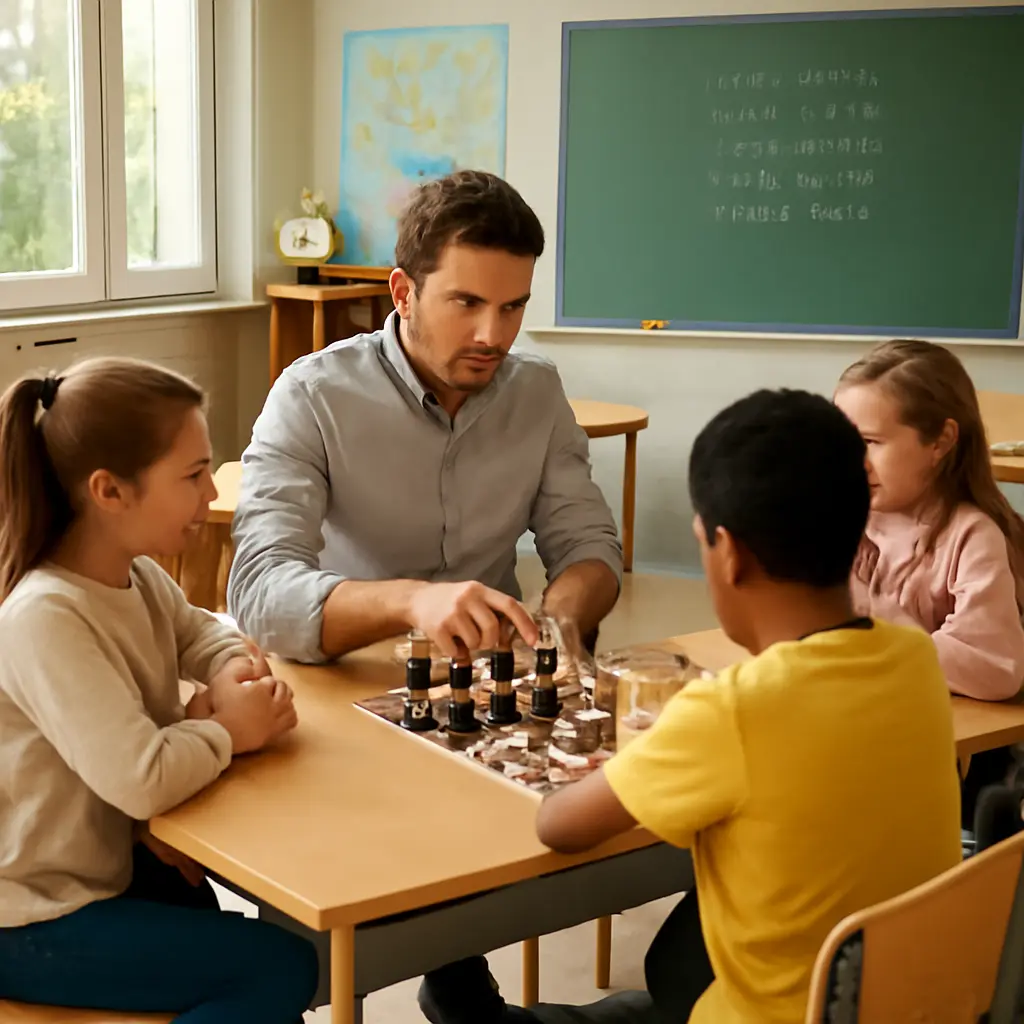
Chess can be a structured way to practice planning, problem-solving, and reflection—but it is not a guaranteed shortcut to higher grades or general intelligence. What classroom teachers can miss is that its educational value depends less on the board itself than on how instruction connects moves to learning goals, makes thinking visible, and gives students equitable chances to participate. Research offers promising but qualified evidence: a 2016 meta-analysis found a small positive association between chess instruction and mathematics performance, while broader claims about transfer to unrelated subjects remain less certain. This article examines chess as a learning tool, the skills it can help students rehearse, what research does and does not establish, and practical ways to teach it responsibly.
Chess instruction as a classroom learning tool
Chess as a learning tool means using the game and its instruction to support specific educational aims, rather than treating play alone as proof that learning has occurred. The National Council for the Social Studies’ College, Career, and Civic Life (C3) Framework emphasizes inquiry, evidence, and reasoned decision-making; chess can provide a compact setting in which students practice some of those behaviors. It does not, by itself, teach every academic skill or guarantee that students will apply a strategy learned on a chessboard to a different task.
The evidence supports a measured approach. In a meta-analysis published in 2016, Giovanni Sala and Fernand Gobet reviewed 24 studies involving 5,110 participants and reported a small positive effect of chess instruction on mathematics achievement, alongside positive findings in some other domains. The authors also cautioned that study quality and design limit strong conclusions about transfer. Teachers should therefore distinguish between a promising instructional activity and a proven, universal intervention.
Chess as explicit instruction
Explicit chess instruction teaches rules, vocabulary, and strategies directly—for example, how pieces move, how to identify a threat, or how to compare candidate moves. This is different from simply placing boards in a classroom and expecting students to discover the game’s educational value. A teacher can make the learning target concrete by asking students to explain why a move is legal, identify the evidence for a proposed tactic, or compare two possible plans.
A useful lesson links one chess concept to one observable thinking behavior. “Look for a check, capture, or threat before moving” is a teachable routine; “become a better thinker” is too broad to assess. The distinction matters because evidence of success should come from students’ explanations and task performance—not simply from enthusiasm or time spent playing.
Chess as guided practice
Guided practice gives students a short position or puzzle, invites them to think aloud, and then supports them in checking their reasoning. The teacher can model a sequence such as noticing a threat, generating options, predicting consequences, and reviewing the result. This structure turns a move into an occasion for deliberate reasoning rather than a guess.
Chess problems can also be adjusted in difficulty. Beginners might identify a safe square or a direct check; more experienced students might compare several lines and justify a plan. Short, well-scaffolded activities are generally easier to connect to a curriculum objective than an unstructured tournament.
Chess as collaborative discussion
Collaborative chess asks students to explain and critique moves with a partner or group. This can support mathematical language, listening, and evidence-based discussion when students are expected to say what they noticed and why a line might work. It also creates opportunities for peer teaching, but discussion needs clear norms so that more experienced players do not dominate every decision.
These instructional forms clarify what chess can offer. The next question is which learning behaviors the game makes visible—and how teachers can assess them without confusing a strong chess result with broad academic mastery.
Chess practice and the thinking skills teachers can observe
Chess practice can create repeated opportunities to plan, anticipate consequences, recognize patterns, and review decisions. These are useful classroom behaviors, but they should be described as skills students practice in a chess context—not automatic benefits that transfer to every subject. Transfer is more plausible when a teacher explicitly names a shared strategy and asks students to use it in a new setting.
Planning and decision-making
Planning in chess involves choosing a goal, considering available moves, and anticipating possible replies. A student may compare whether to protect a piece, create a threat, or improve a position. Teachers can make this process assessable by asking students to state their plan before moving and then explain whether the opponent’s response changed it.
This resembles decision-making in other lessons, such as selecting a method for a mathematics problem or supporting a claim with evidence. The resemblance is an instructional opportunity, not proof of transfer. Teachers can strengthen the connection by using shared language—such as “generate options,” “predict,” and “check the result”—across chess and academic tasks.
Pattern recognition and spatial reasoning
Pattern recognition means noticing familiar arrangements and relationships. Chess players learn recurring features such as forks, pins, open lines, and vulnerable squares. The board also requires students to track positions and piece movement across a two-dimensional grid, making the game a natural context for spatial language and visual analysis.
Teachers can connect this experience to geometry or coordinate systems by asking students to describe squares, lines, diagonals, and routes precisely. A board activity is most useful when students explain the spatial relationship they see; moving pieces without discussion may provide less evidence of what they understand.
Attention, memory, and cognitive load
Chess requires players to keep track of a changing position and consider possible replies. That makes it a demanding activity for attention and working memory, particularly for beginners who are still recalling the rules. The implication for teaching is practical: cognitive effort is not automatically productive. If students are overwhelmed by notation, unfamiliar vocabulary, and complex tactics at once, they may have little capacity left to explain their reasoning.
Teachers can reduce avoidable load by teaching a small number of rules at a time, using diagrams, and providing a visible checklist. Research on learning does not justify claiming that playing chess alone permanently improves general memory. It does support designing tasks in which students can focus on the intended concept rather than struggling to decode every instruction.
Reflection and learning from mistakes
Reflection occurs when students review a decision, identify what happened, and consider an alternative. Chess makes consequences visible: a move may leave a piece undefended or allow an opponent’s tactic. A teacher can turn that moment into feedback by asking, “What did you notice?” and “What information would you look for next time?” rather than treating a loss as evidence of low ability.
This connects chess to formative assessment. A brief post-game review, annotated position, or student explanation can reveal misconceptions more clearly than the final result alone. Once teachers identify the behavior they want students to practice, they can decide whether chess fits a particular curriculum goal and whether the research supports that use.
Evidence for chess education—and its limits
Evidence for chess education is encouraging in some areas but does not support every popular claim. The 2016 meta-analysis by Sala and Gobet reported a small positive effect on mathematics achievement, but the authors noted methodological limitations and the difficulty of establishing far transfer. A positive result in one set of studies does not mean chess will raise every student’s scores, replace direct instruction, or improve unrelated outcomes automatically.
Mathematics outcomes
Mathematics is a plausible area of connection because chess involves patterns, coordinates, comparison, and multi-step reasoning. Sala and Gobet’s 2016 review found a small positive average effect for mathematics outcomes across the included studies. This is evidence of potential, not a guarantee of classroom impact: results can depend on the quality and duration of instruction, the comparison group, student age, and how achievement is measured.
A teacher evaluating a chess-and-math unit should identify the specific mathematics objective in advance. For example, students might use coordinates to locate pieces or explain a sequence of transformations. An assessment should then measure that mathematical understanding directly, rather than assume that improved chess play demonstrates improved mathematics.
Transfer to other subjects
Transfer means applying learning from one context to another. The National Academies’ work on learning and transfer emphasizes that transfer depends on what learners understand and how they recognize similarities between situations. A student who plans in chess may not spontaneously use the same process when writing an essay or conducting a science investigation.
Teachers can make transfer more deliberate by drawing an explicit comparison: “In chess, you checked possible replies before choosing a move. What would count as a possible reply to your claim in this debate?” Students should then practice the strategy in the new subject and receive feedback. Without that bridge, broad claims about chess improving general intelligence go beyond what the evidence establishes.
Motivation, participation, and student outcomes
Chess may increase engagement for students who enjoy strategy, competition, or social play. Engagement can help create opportunities to practice, but it is not the same as academic achievement. Teachers should observe who participates, who speaks, and who receives meaningful turns, rather than relying only on the energy of the room.
Program evaluation should also account for access and selection. If an optional club mainly attracts students who already have time, equipment, or family support, its outcomes may not represent the whole class. Tracking participation alongside learning measures helps schools distinguish the effect of instruction from differences in who joins or stays involved.
Taken together, the research points toward intentional, assessable use rather than a one-size-fits-all chess program. The following practices help teachers preserve the game’s potential while addressing common classroom constraints.
Classroom chess design, access, and assessment
Classroom chess design determines whether students encounter the game as an accessible learning activity or as a competition favoring those who already know how to play. Effective implementation begins with a defined objective, a manageable routine, and an assessment that captures student thinking. It also anticipates equipment, time, language, disability access, and students’ differing levels of experience.
Align lessons to a learning objective
A well-aligned lesson names the academic or reasoning behavior students will demonstrate. A teacher might target coordinate vocabulary, evidence-based explanation, or comparing possible solutions. The chess task then serves as a context for that outcome, not as a substitute for teaching the subject itself.
A simple lesson sequence is to model one idea, let students try a short task, ask them to explain their choices, and close with a transfer question. For example, after comparing two candidate moves, students might identify where they used the same process in a mathematics problem. This helps separate the game’s entertainment value from the learning evidence.
Use formative assessment, not just wins and losses
Formative assessment checks understanding while learning is underway. In chess lessons, useful evidence includes a student’s explanation of a move, a marked-up board position, a partner discussion, or a short reflection on a changed plan. Win–loss records measure game outcomes, but they do not explain what a student understands or how much progress the student has made.
Teachers can use a short rubric with criteria such as identifying a threat, naming a possible response, supporting a choice with evidence, and revising after feedback. The rubric should assess the stated lesson goal and allow beginners to show growth without requiring them to defeat more experienced players.
Make participation equitable and accessible
Equitable implementation means designing participation so that prior experience, disability, language, or access to equipment does not unnecessarily exclude students. Teachers can rotate roles—player, analyst, recorder, and explainer—so that every student has a meaningful contribution. Visual rule cards, large-print or tactile boards where available, and spoken descriptions of positions can offer additional access routes.
Schools should consider the cost of boards and clocks, the availability of digital alternatives, and whether students can practice outside class. Digital chess can increase convenience, but screen access and platform usability also matter. A classroom program should not assume that every learner has a device, internet connection, or prior exposure to chess.
A practical classroom example
In a short mathematics lesson, a teacher introduces the chessboard’s files, ranks, and coordinates, models how to describe a square, and gives pairs a position to locate. Students take turns explaining a route or identifying which squares a piece can reach. The teacher checks understanding with a brief exit response in which each student describes a coordinate and explains the relevant movement rule.
This example does not claim that chess improves all mathematics achievement. It illustrates a defensible connection between a game feature and a specific objective, with evidence the teacher can inspect. A chart for a school pilot could compare participation, lesson-goal mastery, and student explanations before and after instruction, while avoiding causal claims unless the evaluation design supports them.
Conclusion: teach the thinking, not just the game
Chess can give students a memorable setting to practice planning, pattern recognition, explanation, and reflection. Research, including the 2016 meta-analysis by Sala and Gobet, suggests potential benefits—particularly for mathematics—but does not establish chess as a universal academic intervention or prove automatic transfer to unrelated subjects. The central distinction is between playing chess and teaching through chess: the latter requires clear objectives, guided practice, inclusive participation, and evidence of learning.
Teachers considering a chess activity can start small: choose one learning goal, model the relevant thinking routine, assess students’ explanations rather than only game results, and explicitly connect the strategy to another task. Schools should review who participates and evaluate outcomes before expanding a program. For further reading, consult the Sala and Gobet review and the National Academies’ research on learning and transfer.
Sources: Sala, Giovanni, and Fernand Gobet, “Do the Benefits of Chess Instruction Transfer to Academic and Cognitive Skills? A Meta-Analysis,” Educational Research Review, 2016, https://doi.org/10.1016/j.edurev.2016.02.002; National Academies of Sciences, Engineering, and Medicine, How People Learn II: Learners, Contexts, and Cultures, 2018, https://doi.org/10.17226/24783; National Council for the Social Studies, College, Career, and Civic Life (C3) Framework for Social Studies State Standards, 2013, https://www.socialstudies.org/standards/c3.