
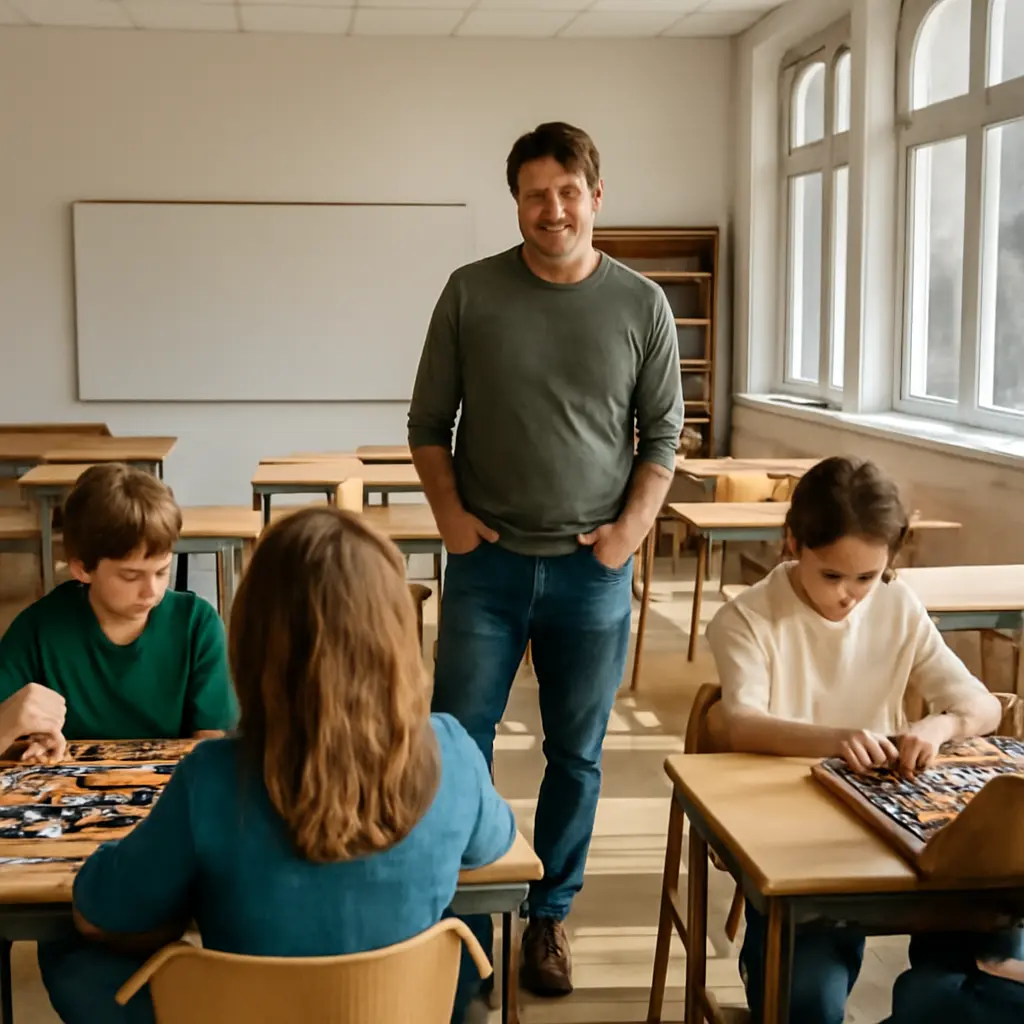
A classroom chess club is a school-based group where students learn, practice, and play chess—often with volunteer or teacher support, limited time, and a wide range of experience levels. What parents may not see is that the club’s value lies in more than the games: students also practice planning, patience, sportsmanship, and coping with mistakes. Research reviews report promising links between chess instruction and some academic outcomes, but results vary, and chess should be treated as a learning opportunity rather than a guaranteed way to raise grades. Inside the room, the work often moves from quick lessons and puzzles to peer coaching, quiet tournament play, and the routines that help children feel welcome.
How Classroom Chess Clubs Build Learning Routines
A classroom chess club is best understood as a structured extracurricular learning environment, not simply a place to play games. The U.S. Department of Education’s 21st Century Community Learning Centers program describes after-school learning as academic enrichment and youth development offered outside regular school hours. Chess clubs can fit that broad model when they combine instruction, practice, and supportive relationships, although their schedules and goals differ from school to school.
The club’s core routines are usually simple: students set up boards, review a concept, solve a position, play, and then reset the room. These repeated steps make the activity accessible to newcomers while giving experienced players a predictable structure. A club might meet once a week for 45 minutes, while another school may run a lunchtime group or a seasonal tournament team.
A predictable session helps beginners join in
A session commonly starts with a short demonstration, such as how a knight moves or why controlling the center matters. Students then try a puzzle or a short practice game before playing a full match. This progression lowers the pressure on beginners: they can learn one idea at a time instead of being expected to understand every rule and strategy immediately.
The structure also gives adult leaders a chance to notice who needs help. A child who repeatedly forgets to check whether a king is in check may benefit from a quick reminder, while a more advanced player can be given a tactical challenge. The point is not to make every student follow the same path, but to keep everyone engaged in a shared activity.
Different club formats serve different needs
Classroom chess clubs may be casual play groups, instructional clubs, school teams, or tournament-preparation groups. A casual club prioritizes access and enjoyment; an instructional club devotes more time to lessons; and a team setting may include rated events, practice schedules, and selection criteria. These formats can overlap, but parents should ask which model a school uses before assuming that club participation means competitive training.
The distinction matters because a beginner may thrive in a relaxed club but feel overwhelmed in a highly competitive setting. Conversely, a student eager for tournaments may need more structured practice than a drop-in group can provide. Clear expectations help families understand what the club can—and cannot—offer.
How Classroom Chess Clubs Teach Thinking Skills
Chess practice asks players to consider possible moves, anticipate responses, and choose among alternatives. These activities resemble planning and problem-solving, but a chess skill does not automatically transfer to every school subject. The strongest educational claims are therefore cautious: chess provides a setting in which students can practice particular habits of thinking, while evidence that those habits produce broad academic gains is mixed.
A 2016 meta-analysis by Giovanni Sala and Fernand Gobet, published in Educational Research Review, examined studies of chess instruction and academic achievement. It found positive average effects in some analyses, while also highlighting limits in the evidence, including variation in study quality and the difficulty of separating chess instruction from other influences. The finding supports thoughtful use of chess as enrichment, not a promise that joining a club will improve every child’s grades.
Planning and evaluating choices
Planning in chess means identifying a goal, considering candidate moves, and checking what the opponent might do next. Even a beginner learns to ask practical questions: Is my king safe? Can this piece be captured? What will happen if I move here? These questions turn a game into repeated practice in evaluating consequences.
An adult can strengthen the learning by asking students to explain a move rather than merely labeling it right or wrong. A student might say, “I moved my bishop because it was under attack,” then notice that the move left a rook undefended. That explanation makes the decision process visible and gives the student a useful way to review mistakes.
Attention, memory, and realistic expectations
A chess game requires players to track piece locations, rules, threats, and the recent sequence of play. This creates opportunities to practice sustained attention and working with information. However, it would be inaccurate to claim that chess alone reliably improves general memory or concentration in all settings; evidence of transfer beyond chess is less certain than the skill students demonstrate during the game itself.
Parents can look for concrete signs of growth: a child pauses before moving, checks for an opponent’s threat, or can describe why a plan failed. Those observations are more meaningful than assuming that a child’s chess rating directly measures classroom attention or overall intelligence.
How Classroom Chess Clubs Support Social and Emotional Growth
A classroom chess club is also a small social community. Students take turns, negotiate rules, share equipment, and respond to winning and losing in front of peers. These interactions can give children practice with patience and respectful disagreement, provided adults establish clear norms and intervene when needed.
The Collaborative for Academic, Social, and Emotional Learning describes social and emotional learning through competencies that include self-management, relationship skills, and responsible decision-making. A chess club is not automatically a formal social-emotional learning program, but its ordinary routines can create chances to practice those competencies in a concrete setting.
Good sportsmanship is taught, not assumed
Good sportsmanship includes greeting an opponent, following agreed rules, accepting the result, and resetting the board for the next game. These actions may seem small, but they make competition safer and more welcoming. Club leaders often model how to offer a handshake or congratulate an opponent without turning a loss into a public embarrassment.
For younger players, the adult’s response to a difficult moment matters. If a student becomes upset after a blunder, a leader can acknowledge the disappointment, give the child a moment, and later ask what the position taught them. The aim is not to dismiss frustration, but to help students recover and rejoin the activity.
Peer coaching creates belonging
Students often learn from one another in ways a short adult lesson cannot provide. An experienced player may show a beginner how to castle, explain a familiar opening trap, or help reset a game after an illegal move. When peer coaching is respectful, it gives the more experienced student responsibility and the newer player a friendly route into the group.
That support works best when clubs avoid treating stronger players as unpaid instructors who must always help others. Leaders can rotate partners, offer optional mentoring roles, and make sure beginners receive direct instruction too. Belonging depends on students feeling welcome as players, not only as recipients of help.
How Classroom Chess Clubs Manage Competition and Inclusion
Competition can motivate students, but it can also create barriers if ratings, speed, or selection dominate the club. Inclusive programs make room for different ages, experience levels, language backgrounds, and learning needs. They also provide equipment, clear rules, and more than one way to participate, such as puzzles, casual games, team play, or tournament matches.
The U.S. Chess Federation’s scholastic resources and tournament framework illustrate how organized youth chess can extend beyond informal school play. A school club does not need to enter rated events, however, and participation in a tournament should be a choice informed by the student’s readiness and interest.
Pairing students fairly
Pairing is the process of deciding who plays whom. In a casual club, adults may pair students by approximate experience or rotate partners; in a tournament, organizers may use formal pairing systems and published rules. Fair pairings matter because repeated mismatches can frustrate beginners and make games less useful for both players.
A practical club can mix pairings: one round with a similarly experienced player, another with a supportive peer, and occasional adult-guided practice. This approach avoids making a child’s entire club experience depend on a single win-loss record.
Access, equipment, and accommodations
A club’s welcome is shaped by practical details: whether boards and pieces are provided, whether participation costs money, whether the meeting time works for families, and whether students can join without prior knowledge. Schools can reduce barriers by lending equipment, offering beginner instruction, and explaining transportation or pickup arrangements clearly.
Students may also need adaptations, such as larger pieces, a tactile board, extra time, a quieter place to play, or instructions presented in more than one format. The appropriate support depends on the student. Asking families and students what helps is more reliable than assuming one accommodation fits everyone.
What Parents Can Ask About Classroom Chess Clubs
Parents can learn a great deal by asking how the club balances instruction, free play, and competition. It is also useful to ask who supervises sessions, how beginners are welcomed, whether the school supplies boards, and what happens when a child loses interest or feels discouraged. These questions focus on the actual club experience rather than on broad claims about chess’s benefits.
Questions that reveal the club’s purpose
- Is the club designed for beginners, experienced players, or both?
- How much time is spent on lessons, puzzles, and games?
- Are tournaments optional, and are there additional fees?
- How are students paired, and how does the club handle conflict or frustration?
- What equipment or accommodations are available?
These questions can also help a family decide whether the club matches a child’s goals. A student seeking a calm weekly activity may prefer a noncompetitive group, while a tournament-minded player may want to know whether the club offers coaching or event preparation.
Conclusion: The Classroom Chess Club Beyond the Board
What happens inside a classroom chess club is a mix of instruction, independent decision-making, peer interaction, and careful routines. Students learn rules and strategies, but they also get repeated chances to explain choices, handle setbacks, respect opponents, and include newcomers. Research offers reason to view chess as promising enrichment, while cautioning against treating it as a guaranteed academic intervention.
For parents, the best next step is to ask how a particular club is run and whether its atmosphere fits their child. For schools, the broader lesson is that access, supportive leadership, and a balance between learning and competition matter as much as the chessboard itself. A well-run club can make strategic play a shared learning experience—one move, one conversation, and one student at a time.
Sources: U.S. Department of Education, 21st Century Community Learning Centers, https://www.ed.gov/grants-and-programs/formula-grants/school-improvement-grants/21st-century-community-learning-centers; Sala, Giovanni, and Fernand Gobet, “Do the benefits of chess instruction transfer to academic and cognitive skills? A meta-analysis,” Educational Research Review, 2016, https://doi.org/10.1016/j.edurev.2016.02.002; Collaborative for Academic, Social, and Emotional Learning, What Is the CASEL Framework?, https://casel.org/fundamentals-of-sel/what-is-the-casel-framework/; U.S. Chess Federation, Scholastic Chess, https://new.uschess.org/scholastic.