
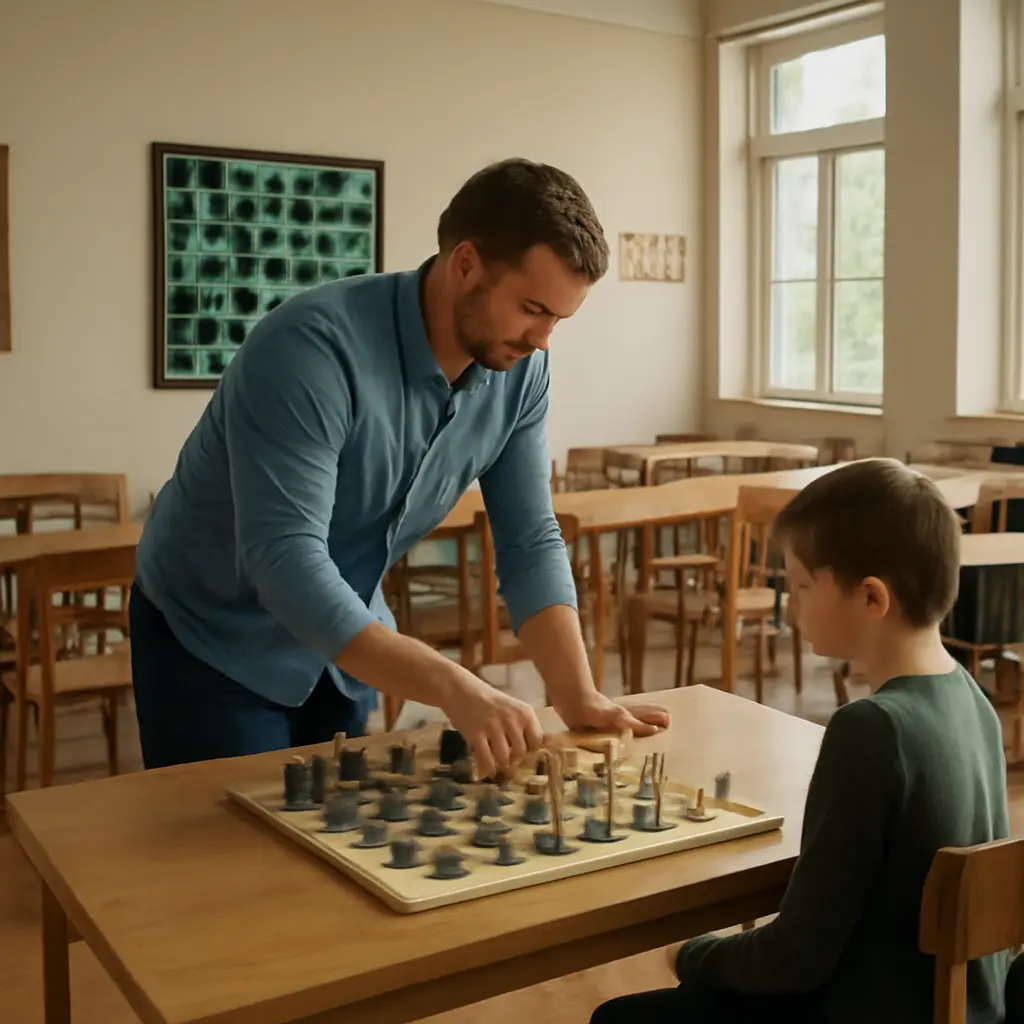
Parents who are new to chess can help their children compete by creating steady routines, supporting good learning habits, and making tournaments feel manageable—even without knowing how to play. Chess is a game of skill, but a child’s progress also depends on practical support: access to instruction and practice, sleep and emotional regulation, and a family environment that treats results as feedback rather than a measure of worth. Research on deliberate practice and child development offers useful guidance, while chess organizations’ tournament rules show where parents can help without interfering at the board. The key is not to become the coach overnight; it is to build the conditions in which a child can learn, enjoy competition, and keep improving.
Building Competitive Support for Young Chess Players
Competitive support means the practical and emotional help that allows a young player to prepare, take part in events, and learn from the experience. It is different from coaching: a parent can arrange practice, ask thoughtful questions, and provide calm encouragement without selecting moves or analyzing positions. This distinction matters because children need room to develop independent judgment, while parents can make participation more consistent and less stressful.
The National Center for Education Statistics reported that 55% of U.S. children ages 6–17 participated in sports or other athletic activities outside school in 2020–21; chess is not an athletic sport in that survey, but the finding illustrates how organized activities depend on family time and logistics. Meanwhile, a meta-analysis by Brooke Macnamara, David Hambrick, and Frederick Oswald found that deliberate practice accounted for about 26% of the variance in performance in games, a category that includes chess. Practice matters, but it is not the whole explanation for success—making a sustainable, supportive environment important.
Parent support is not the same as chess instruction
Chess instruction teaches the game’s concepts and skills; parent support helps a child access and use that instruction. A parent who does not know chess can still ask whether the child has a lesson, help protect practice time, arrange transportation, and encourage the child to explain what they are learning. When a position is beyond the parent’s knowledge, saying “Let’s ask your coach” is more helpful than guessing or presenting an uncertain answer as fact.
A child’s competitive development has several parts
Competitive development includes chess knowledge, tournament experience, emotional skills, and the ability to review mistakes. These parts grow at different rates. A child may understand tactics but struggle with time management, or play confidently in practice but feel nervous in a rated event. Treating improvement as a combination of skills helps parents avoid judging progress only by wins, rating changes, or a single tournament result.
Creating a Learning Routine Without Becoming the Coach
A useful chess routine is regular, appropriately challenging, and sustainable. The American Psychological Association describes deliberate practice as focused effort aimed at improving specific aspects of performance, usually with feedback; simply spending more hours does not guarantee better learning. For families, the practical implication is to prioritize a manageable routine with a clear purpose over long sessions driven by pressure.
Use short, consistent practice blocks
Short practice blocks give children a predictable opportunity to work without making chess feel like an all-day obligation. A family might agree on several sessions each week, with the child choosing from coach-assigned puzzles, a review of a recent game, or a practice game. The right amount depends on age, interest, school demands, and the coach’s plan; families should adjust if practice regularly leads to exhaustion or conflict.
Make practice specific and reviewable
Specific practice targets one skill at a time—for example, checking for undefended pieces, calculating forcing moves, or recording moves accurately. After a session, a parent can ask, “What were you working on?” or “What did you notice?” These questions invite reflection without requiring the parent to judge whether a move was best. A coach or a trusted chess-learning resource can provide technical feedback.
Choose tools that match the child’s needs
A child may learn through a local club, a qualified coach, books, chess software, or online lessons. Parents can compare options by asking whether the material fits the child’s level, provides explanations rather than only scores, and supports safe, age-appropriate participation. The U.S. Chess Federation’s scholastic resources and event information can help families understand organized chess, while a child’s coach can recommend materials that reinforce current lessons.
Preparing for Tournaments and Competition
Tournament preparation combines chess readiness with practical planning. Events may involve long rounds, waiting periods, notation requirements, unfamiliar venues, and rules that differ from casual play. Parents can reduce avoidable stress by learning the event schedule and regulations in advance, while leaving decisions at the board to the player.
Know the rules and event expectations
Before an event, check registration details, time controls, notation requirements, equipment, and the organizer’s policies for parents and spectators. The U.S. Chess Federation’s Official Rules of Chess explain tournament procedures, including player responsibilities and conduct. Parents should avoid giving advice during a game; tournament rules generally prohibit outside assistance, and even well-meant signals can distract a child or create a rules problem.
Plan food, rest, travel, and downtime
A practical tournament plan includes transportation, water, suitable snacks, rest, and a calm place to wait between rounds where permitted. The Centers for Disease Control and Prevention recommends 9–12 hours of sleep for children ages 6–12 and 8–10 hours for teenagers ages 13–18. Those sleep ranges are general health guidance, not a chess-performance guarantee, but they underline why late-night cramming before an event is usually a poor trade-off.
Set process goals instead of demanding wins
A process goal focuses on a controllable behavior, such as checking for threats before moving, using time carefully, or recording moves correctly. Outcome goals—winning a section or gaining rating points—depend partly on the opponent and the day’s pairings. Parents can help a child choose one or two process goals before the tournament and discuss afterward whether the child used them, regardless of the score.
Supporting Confidence, Resilience, and Independence
Chess competition can bring excitement, disappointment, and pressure, sometimes within the same event. Supportive parenting does not mean dismissing those feelings; it means helping a child handle them while keeping the relationship bigger than the result. The American Academy of Pediatrics’ guidance on youth sports emphasizes enjoyment, development, and positive adult support—principles that also apply to children’s competitive activities such as chess.
Respond to results with curiosity
After a game, begin with the child’s experience rather than an unsolicited analysis. Questions such as “What part felt hardest?” or “What would you like to remember for next time?” let the player identify a lesson. If the child does not want to talk immediately, allow a break and return to the game later with a coach or study tool. One result is information, not a verdict on talent.
Praise effort, strategy, and sportsmanship
Specific praise reinforces behaviors a child can repeat: preparing consistently, staying composed after a mistake, treating an opponent respectfully, or finishing a game responsibly. This is more useful than labeling a child a “natural” or praising only victories. The American Psychological Association’s discussion of growth mindset cautions that praise should be meaningful and tied to learning or effort rather than offered as empty reassurance.
Give children ownership as their skills grow
Independence develops when children gradually take responsibility for their own chess decisions and routines. A younger player may need help packing a set and checking the schedule; an older child can take increasing responsibility for preparation, game records, and choosing a post-event review question. Parents remain responsible for safety and logistics, but the player should increasingly own the learning process.
A Practical First-Tournament Plan for Chess-New Parents
A simple plan can make a first event feel less intimidating for the whole family. For example, imagine a child entering a local weekend scholastic tournament while the parent is still learning the rules. The parent can focus on logistics and emotional support, while the coach or organizer answers technical questions.
- Before registering, ask the child what they hope to experience and check that the event is suitable for their age and level.
- Read the organizer’s schedule, equipment list, notation guidance, and parent conduct rules.
- Agree on one controllable goal, such as checking for an opponent’s threat before each move.
- Prepare travel, food, water, and an appropriate bedtime without turning the evening into a last-minute study marathon.
- After each round, offer encouragement and ask whether the child wants to talk, take a break, or wait until later.
- After the event, note one enjoyable moment and one question to take to the coach or next practice.
This approach makes the parent an effective part of the child’s support system without creating pressure to become an expert. It also gives the child a repeatable structure that can be adjusted as tournament experience grows.
Conclusion: Help the Young Player Thrive, Not Just Score
Parents new to chess can contribute meaningfully through competitive support, sustainable learning routines, thoughtful tournament preparation, and encouragement that builds resilience and independence. Research suggests deliberate practice contributes to performance, but it does not explain every difference in results; sleep, instruction, experience, motivation, and individual circumstances matter too. Parents do not need to provide chess theory to help. They can create reliable conditions for learning, respect tournament rules, focus conversations on controllable goals, and keep a child’s well-being ahead of any single rating or result. Start by asking the child what they want from chess, agree on a manageable routine, and use the next event as an opportunity to learn together.
Sources: Macnamara, Brooke N., David Z. Hambrick, and Frederick L. Oswald, “Deliberate Practice and Performance in Music, Games, Sports, Education, and Professions: A Meta-Analysis,” Psychological Science, 2014, https://journals.sagepub.com/doi/10.1177/0956797614535810; National Center for Education Statistics, “Children’s Participation in Sports and Other Physical Activities,” The Condition of Education, https://nces.ed.gov/programs/coe/indicator/cge; American Psychological Association, “The Role of Deliberate Practice in the Acquisition of Expert Performance,” https://www.apa.org/ed/precollege/psychology-teacher-network/introductory-psychology/deliberate-practice; U.S. Chess Federation, Official Rules of Chess, https://new.uschess.org/sites/default/files/media/documents/US-Chess-Federation-Official-Rules-of-Chess-7th-Edition-2007.pdf; U.S. Chess Federation, Scholastic Chess, https://new.uschess.org/scholastic; Centers for Disease Control and Prevention, “About Sleep,” https://www.cdc.gov/sleep/about/index.html; American Academy of Pediatrics, “Organized Sports for Children, Preadolescents, and Adolescents,” Pediatrics, https://publications.aap.org/pediatrics/article/143/6/e20190997/37175/Organized-Sports-for-Children-Preadolescents-and; American Psychological Association, “What Is a Growth Mindset?” https://www.apa.org/ed/schools/teaching-learning/top-twenty/growth-mindset.