
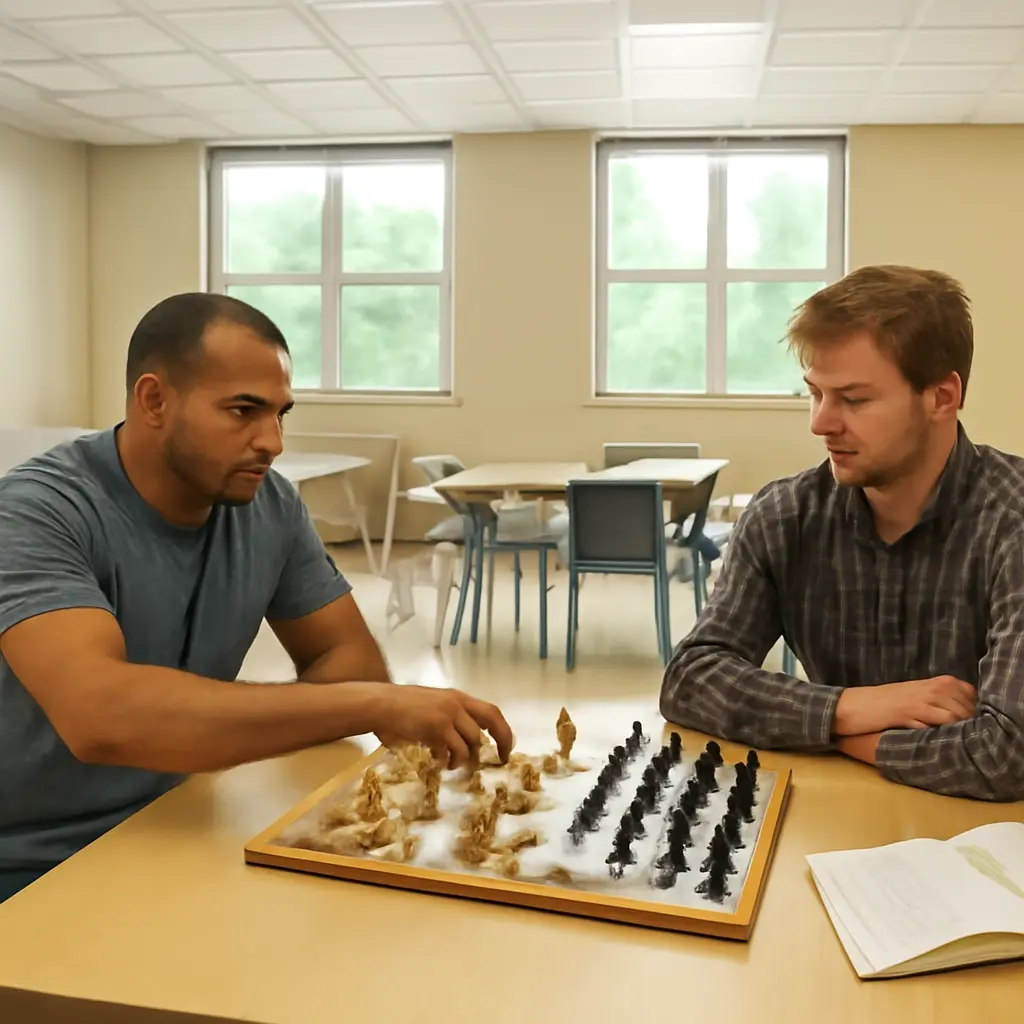
Chess may help some people practice skills that matter when reading—such as sustaining attention, planning ahead, and interpreting relationships—but research does not establish that playing chess reliably makes people better readers. Chess is a rule-based strategy game; reading comprehension is the ability to build meaning from written text. Studies of chess instruction and academic performance report mixed results, and improvements in one task do not automatically transfer to another. The most defensible answer is that chess can complement reading instruction, but it should not replace explicit teaching of vocabulary, fluency, and comprehension strategies.
Chess and reading comprehension: what the evidence says
The proposed connection is plausible because both chess and reading can involve attention, working memory, inference, and planning. A chess player tracks pieces and possible moves; a reader connects details, remembers earlier information, and draws conclusions. However, sharing some mental processes is not proof that practice in one activity improves performance in the other. Researchers call improvement across different tasks “transfer,” and far transfer—gains in a skill substantially different from the one practiced—is especially difficult to demonstrate.
The distinction matters in schools, where chess programs are sometimes promoted as a way to raise academic achievement. A 2016 meta-analysis by Giovanni Sala and Fernand Gobet found that chess instruction was associated with positive academic outcomes in some studies, but the evidence was weakened by methodological limitations, including small samples and inadequate control groups. The findings support further investigation, not a guarantee that chess lessons improve reading comprehension.
What “reading comprehension” includes
Reading comprehension is the process of constructing meaning from text, drawing on accurate word reading, language knowledge, and reasoning. The RAND Reading Study Group described it as the process of simultaneously extracting and constructing meaning through interaction with written language. Readers need to recognize words, understand vocabulary and sentence structure, connect ideas across a passage, and monitor whether the text makes sense.
These components are related but distinct. A reader may decode words accurately yet struggle to infer a character’s motive; another may understand spoken language well but read too slowly to follow a complex passage. The National Reading Panel’s 2000 report identified vocabulary and comprehension-strategy instruction among important areas of reading research. Chess may offer practice in attention or inference, but it does not directly teach the meanings of words or how written sentences are structured.
What “transfer” means in chess research
Transfer occurs when knowledge or a skill learned in one setting improves performance in another. Near transfer might mean that chess practice improves performance on a closely related planning task. Far transfer would mean that chess practice improves a substantially different outcome, such as understanding a history passage. The farther apart the activities are, the more important it is to test the outcome directly rather than assume that shared mental demands will produce gains.
In a review of chess and education research, Sala and Gobet noted that study design affects how confidently researchers can attribute academic changes to chess. Students who choose chess may already differ in motivation, family support, or prior achievement from students who do not. Stronger evidence requires random assignment where feasible, comparison groups that receive similar attention, and standardized reading measures administered before and after instruction.
How chess skills might connect to reading
Chess and reading are not the same activity, but they can involve overlapping habits of thought. Those possible links are best treated as hypotheses: they explain why chess might support some learners, while leaving open whether the benefits transfer to reading tests or everyday comprehension.
Attention and working memory
Working memory is the limited capacity to hold and use information over a short period. During a chess game, a player may remember a piece’s position while considering a possible move. During reading, a person may retain a detail from an earlier paragraph while interpreting a later one. Sustained attention also helps readers stay with a passage and notice when meaning breaks down.
The overlap is real at the level of general cognitive demands, but it does not establish that chess training increases working-memory capacity or improves comprehension. A 2016 review by Sala and Gobet concluded that claims about broad cognitive benefits should be interpreted cautiously because many studies had weaknesses that could inflate apparent effects. Chess may give students a structured reason to concentrate; whether that habit carries over to reading must be measured rather than presumed.
Inference, prediction, and checking assumptions
Inference means deriving information that is not stated explicitly. Chess players infer what an opponent may be planning from the board; readers infer meaning from clues, context, and relationships between ideas. Both activities can involve generating possibilities and checking them against available evidence.
The useful reading connection is not simply “think ahead.” Readers must support interpretations with textual evidence, while chess players must test candidate moves against the board and rules. An instructor can make the connection explicit by asking a student to explain a chess choice, then asking the student to identify evidence for an inference in a passage. Without that deliberate bridge, the two activities may remain separate experiences.
Planning and monitoring
In chess, planning involves considering possible sequences of moves and revising a plan when circumstances change. In reading, monitoring means noticing confusion, rereading, asking questions, or changing pace when a passage becomes difficult. Both can encourage a person to pause, evaluate a situation, and adjust an approach.
Reading researchers commonly teach monitoring through strategies such as summarizing, questioning, clarifying, and predicting. Chess alone does not provide practice with these text-specific strategies. It may nevertheless offer a motivating context for discussing how to make a plan, check whether it is working, and revise it—a connection teachers can explicitly reinforce during reading lessons.
What studies show—and what they do not
Research on chess education has examined academic achievement, mathematical performance, and cognitive skills, but fewer studies have directly tested reading comprehension as a primary outcome. Findings across the broader literature are mixed, and results from one subject area should not be presented as proof of gains in another.
The 2016 meta-analysis and its cautions
Sala and Gobet’s meta-analysis, published in Educational Research Review, combined studies of chess instruction and academic or cognitive outcomes. It reported a positive overall pattern, while warning that the underlying research often lacked the controls needed to establish strong causal claims. The authors highlighted problems such as small samples, limited randomization, and the possibility of publication bias.
A meta-analysis can summarize existing studies, but it cannot make weak studies equivalent to large, carefully controlled trials. Nor does a general academic outcome answer the specific question of whether chess improves reading comprehension. When a study reports improved grades or broad achievement, readers should check which subjects were tested, how outcomes were measured, and whether reading was assessed separately.
Why results can look stronger than they are
Several factors can make chess programs appear more effective than the game itself may be. Students may receive extra adult attention, spend more time in an enriching activity, or become more motivated to attend school. Programs may also attract students who are already interested in puzzles or academic challenges. These influences are valuable in their own right, but they complicate the claim that chess specifically caused a reading improvement.
A rigorous study would compare chess instruction with an equally engaging activity, provide both groups with similar instructional time, and measure reading using validated assessments. It would also report participant numbers, program duration, attendance, and whether gains persist. Until more direct evidence is available, the fairest conclusion is that chess is a promising enrichment activity, not a proven reading intervention.
Using chess alongside reading instruction
Chess can still have educational value even if its effect on reading is uncertain. It can be enjoyable, socially engaging, and a reason to practice explaining decisions. The strongest practical approach is to use it as a complement to evidence-based literacy instruction and deliberately connect game discussion to reading skills.
Make the thinking connection explicit
After a game or puzzle, ask students to describe what they noticed, what they predicted, and what evidence changed their minds. Then use parallel questions with a short text: What clue supports that inference? What might happen next? Which detail should you reread? Naming the shared process helps students see that strategies such as predicting and checking evidence can be used beyond the chessboard.
This approach should supplement, not displace, direct reading practice. Students still need instruction matched to their needs, including decoding and fluency support when appropriate, vocabulary development, background knowledge, and guided work with comprehension. For children who find chess frustrating or inaccessible, a different game or activity can offer the same opportunity to explain choices and revise plans.
A practical way to evaluate a program
Schools and families can assess a chess-and-reading program by setting a specific goal before it begins. If the goal is reading comprehension, measure comprehension directly rather than relying on chess skill, enthusiasm, or general grades. Track participation and instructional time, and consider whether students also receive explicit literacy teaching.
- Choose a reading outcome, such as understanding literal details, making text-based inferences, or summarizing a passage.
- Use the same reliable measure before and after the program, while recognizing that short-term changes may reflect normal development or practice effects.
- Compare results with a similar group where possible, and account for differences in attendance and additional reading support.
- Ask students whether chess increases their willingness to persist with challenging tasks, but treat motivation as a separate outcome from comprehension.
Conclusion: chess can support habits, but it is not a reading shortcut
Chess may give learners practice with attention, planning, inference, and checking decisions—habits that can also be useful during reading. But the evidence does not show that playing chess by itself reliably improves reading comprehension. Research reviews find possible academic benefits while emphasizing limitations in the studies, and direct evidence about reading remains less conclusive than broad claims often suggest.
For parents and educators, the practical takeaway is to enjoy chess for its own benefits and connect it intentionally to text-based thinking when useful. Keep reading instruction explicit, measure reading outcomes directly, and look for stronger controlled research before treating chess as an intervention. Further reading from the National Reading Panel and the RAND Reading Study Group can help distinguish established literacy practices from promising enrichment activities.
Sources: Sala, Giovanni, and Fernand Gobet, “Do the benefits of chess instruction transfer to academic and cognitive skills? A meta-analysis,” Educational Research Review, 2016, https://doi.org/10.1016/j.edurev.2016.02.002; RAND Reading Study Group, Reading for Understanding: Toward an R&D Program in Reading Comprehension, 2002, https://www.rand.org/pubs/monograph_reports/MR1465.html; National Reading Panel, Teaching Children to Read: An Evidence-Based Assessment of the Scientific Research Literature on Reading and Its Implications for Reading Instruction, 2000, https://www.nichd.nih.gov/sites/default/files/publications/pubs/nrp/Documents/report.pdf.