
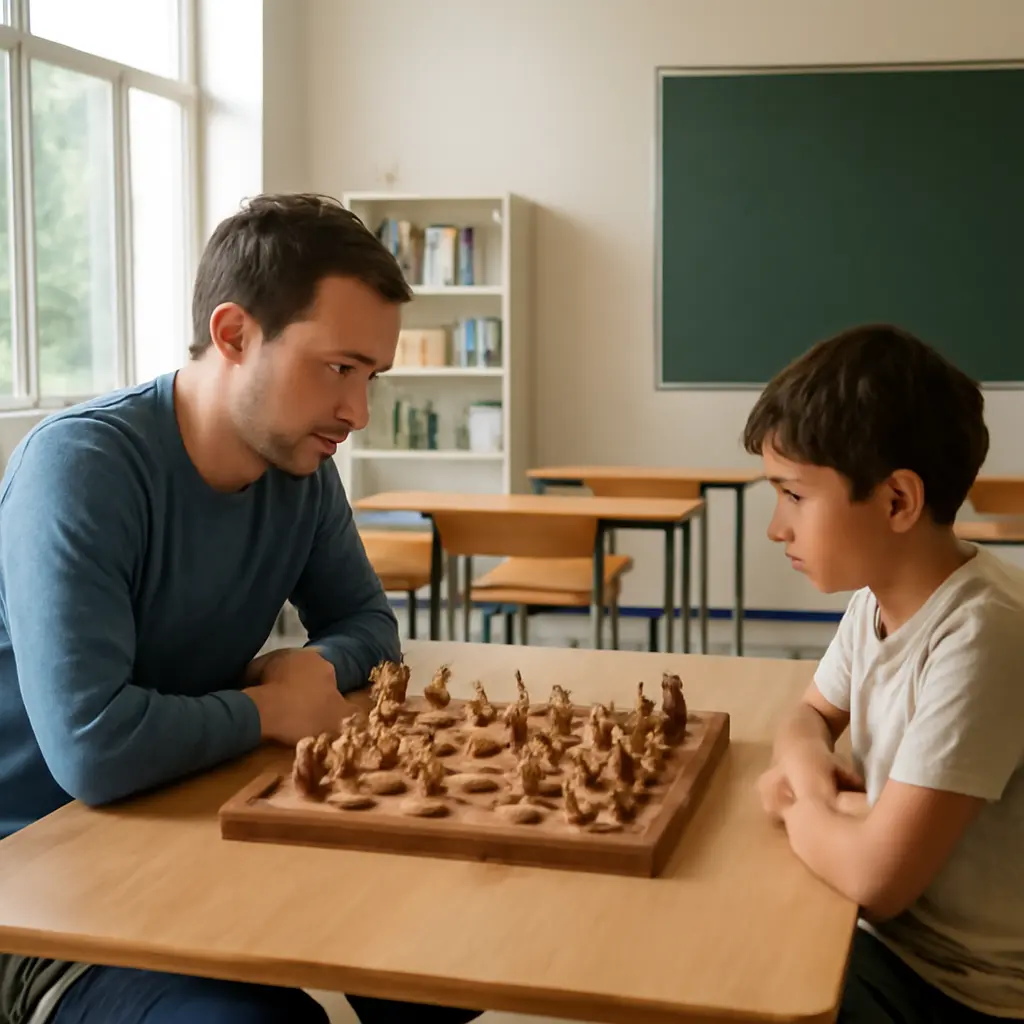
Chess is a rule-based strategy game in which players plan moves, anticipate an opponent’s responses, and adapt to changing positions. Its demands make it a useful setting for studying attention, memory, planning, and learning—but chess is not a shortcut to a generally “smarter” brain. Research suggests that chess instruction can support some academic and cognitive skills, especially when lessons are sustained and well designed; evidence for broad, lasting transfer beyond chess remains mixed. Understanding the brain mechanisms, what studies actually show, and how chess can fit into childhood learning helps families and schools use the game realistically.
Chess engages cognitive skills through structured practice
Cognitive science describes chess as a complex, goal-directed activity that draws on several mental processes at once. These include selective attention, working memory, pattern recognition, decision-making, and executive functions such as planning and inhibiting an impulsive move. No single brain region “does chess”; performance depends on interacting networks that support perception, memory, evaluation, and action.
A crucial distinction is between near transfer and far transfer. Near transfer occurs when practice improves closely related tasks—for example, recognizing familiar chess positions. Far transfer means improvement in a substantially different area, such as general mathematics or intelligence. Chess clearly builds chess expertise, but researchers continue to debate how reliably those gains transfer to unrelated school skills.
Attention and working memory
Working memory is the limited-capacity system used to hold and manipulate information briefly. During a game, a child may keep candidate moves in mind, compare likely replies, and remember the consequences of earlier choices. Attention helps the child focus on relevant pieces and threats while resisting distraction. With practice, familiar configurations become easier to recognize, reducing the effort needed to evaluate them.
This does not mean chess permanently expands working-memory capacity. Rather, expertise often makes domain-specific information easier to organize and retrieve. The classic research of chess psychologists William Chase and Herbert Simon found that skilled players remember meaningful chess positions far better than novices, but that advantage depends substantially on chess knowledge and recognizable patterns.
Planning, inhibition, and decision-making
Executive functions help people set goals, compare options, monitor progress, and stop an immediate response when it conflicts with a longer-term plan. Chess naturally exercises these processes: a player must consider consequences, avoid overlooking an opponent’s threat, and sometimes reject an attractive move because it creates a weakness. These are useful opportunities to practise deliberate thinking, although a chess activity is not equivalent to a clinical test or treatment for executive-function difficulties.
Pattern recognition and expertise
Chess expertise involves learning recurring relationships among pieces, not merely memorizing isolated moves. A player who has studied many positions can identify familiar tactical patterns—such as a fork or a pin—and use them to guide analysis. This illustrates a broader learning principle: background knowledge can make complex problems more manageable. It also explains why beginners and experienced players may approach the same board very differently.
Chess instruction can support childhood learning, with limits
Educational chess is the use of chess activities or lessons to support learning and development, either as a dedicated subject or as part of classroom instruction. Its strongest and least controversial outcome is improved chess knowledge and playing skill. Possible benefits for academic performance and general cognition are encouraging in some studies, but study design, teaching quality, age, and the comparison group all affect the results.
What research says about mathematics and achievement
A 2016 meta-analysis by Giovanni Sala and Fernand Gobet examined studies of chess instruction and academic or cognitive outcomes. It reported a positive average effect across the included studies, while also emphasizing important limitations: many studies were small or methodologically weak, and publication bias could inflate estimated benefits. The authors cautioned that the evidence did not establish chess as a general-purpose way to raise intelligence.
Individual programs have reported gains in mathematics or other school outcomes, but results are not uniform. A child might benefit because chess provides practice in persistence, spatial reasoning, or structured problem-solving; alternatively, observed gains may reflect extra adult attention, motivation, or time spent learning. Stronger studies use comparison groups and measure outcomes beyond the chess skills taught.
Transfer is not automatic
Transfer depends on whether learners can recognize that a skill used in one setting applies in another. A child who learns to look for threats on a chessboard may not spontaneously use the same strategy to check arithmetic or revise an essay. Teachers can encourage transfer by explicitly connecting chess habits—such as considering alternatives or checking consequences—to comparable classroom tasks, then giving students opportunities to practise the connection.
Motivation, confidence, and social learning
Chess can make practice engaging because moves produce visible consequences and games offer clear challenges. A well-run club also gives children opportunities to take turns, follow shared rules, cope with winning and losing, and discuss decisions. These are plausible educational benefits, but they depend on a supportive environment. Pressure to win, exclusion of beginners, or excessive screen time can undermine enjoyment and participation.
Effective chess learning depends on age-appropriate teaching
Chess instruction for children works best when it treats the game as a learning activity rather than a test of innate ability. Lessons should match students’ developmental levels, provide feedback, and allow repeated practice without making rating or tournament success the only measure of progress.
Begin with simple rules and meaningful positions
Young learners can start with piece movement, check, and basic goals before taking on long games or complicated notation. Short puzzles and mini-games that use only a few pieces reduce cognitive load and help children focus on one idea at a time. As competence grows, instructors can introduce tactics, planning, and full-game analysis.
Use reflection to connect play with learning
After a game, a child can identify a decision that worked, a missed possibility, and one idea to try next time. This kind of reflection turns a result into feedback. Adults should ask open questions—such as “What did you consider?”—rather than simply supplying the best move, so children practise explaining and evaluating their reasoning.
Make access inclusive and sustainable
Chess programs should welcome beginners, provide accessible equipment and instruction, and avoid assuming that every child has a set, internet access, or prior exposure to the game. Pairing instruction with free play can preserve enjoyment. Schools and families should also treat chess as one option among many valuable activities, not as a replacement for sleep, physical activity, reading, or direct support in subjects where a child needs help.
How to interpret the evidence and use chess well
The most defensible conclusion is that chess offers rich practice in a distinctive set of cognitive and social tasks, while claims of sweeping academic transformation exceed what current evidence can guarantee. Researchers studying transfer have repeatedly noted that training benefits are often strongest on tasks similar to the training itself. Chess may contribute to a child’s learning environment, but its value should be judged alongside program quality, student interest, and measurable goals.
A useful way to visualize the evidence is a three-column chart labeled “well established,” “promising but variable,” and “not established.” Chess skill belongs in the first column; improvements in some academic or cognitive measures belong in the second; a guaranteed increase in general intelligence belongs in the third. Such a chart helps families distinguish plausible benefits from marketing claims.
For practical evaluation, schools can track participation, enjoyment, chess-specific progress, and any academic outcomes they hope to influence. Comparing results with a suitable alternative activity—and accounting for attendance and instructional time—can clarify whether a program is meeting its aims. The American Academy of Pediatrics’ guidance on healthy media use also offers a useful reminder for digital chess: balance screen activities with sleep, movement, and offline relationships.
Conclusion: chess is a learning tool, not a cognitive shortcut
Chess engages attention, working memory, planning, inhibition, and pattern recognition, and structured instruction can give children an enjoyable way to practise these skills. Research supports clear gains in chess expertise and suggests possible academic benefits, but evidence for broad transfer is mixed and does not justify promises of a general intelligence boost. Parents and educators can get the most from chess by using age-appropriate lessons, encouraging reflection, keeping participation inclusive, and measuring outcomes realistically. Further reading on cognitive transfer and educational research can help schools design programs that are both engaging and evidence-informed.
Sources: Chase, William G., and Herbert A. Simon, “Perception in Chess,” Cognitive Psychology, 1973, https://doi.org/10.1016/0010-0285(73)90004-2; Sala, Giovanni, and Fernand Gobet, “Do the Benefits of Chess Instruction Transfer to Academic and Cognitive Skills? A Meta-Analysis,” Educational Research Review, 2016, https://doi.org/10.1016/j.edurev.2016.02.002; Sala, Giovanni, and Fernand Gobet, “Cognitive Training Does Not Enhance General Cognition,” Trends in Cognitive Sciences, 2019, https://doi.org/10.1016/j.tics.2018.10.004; American Academy of Pediatrics, “Media and Children,” https://www.aap.org/en/patient-care/media-and-children/