
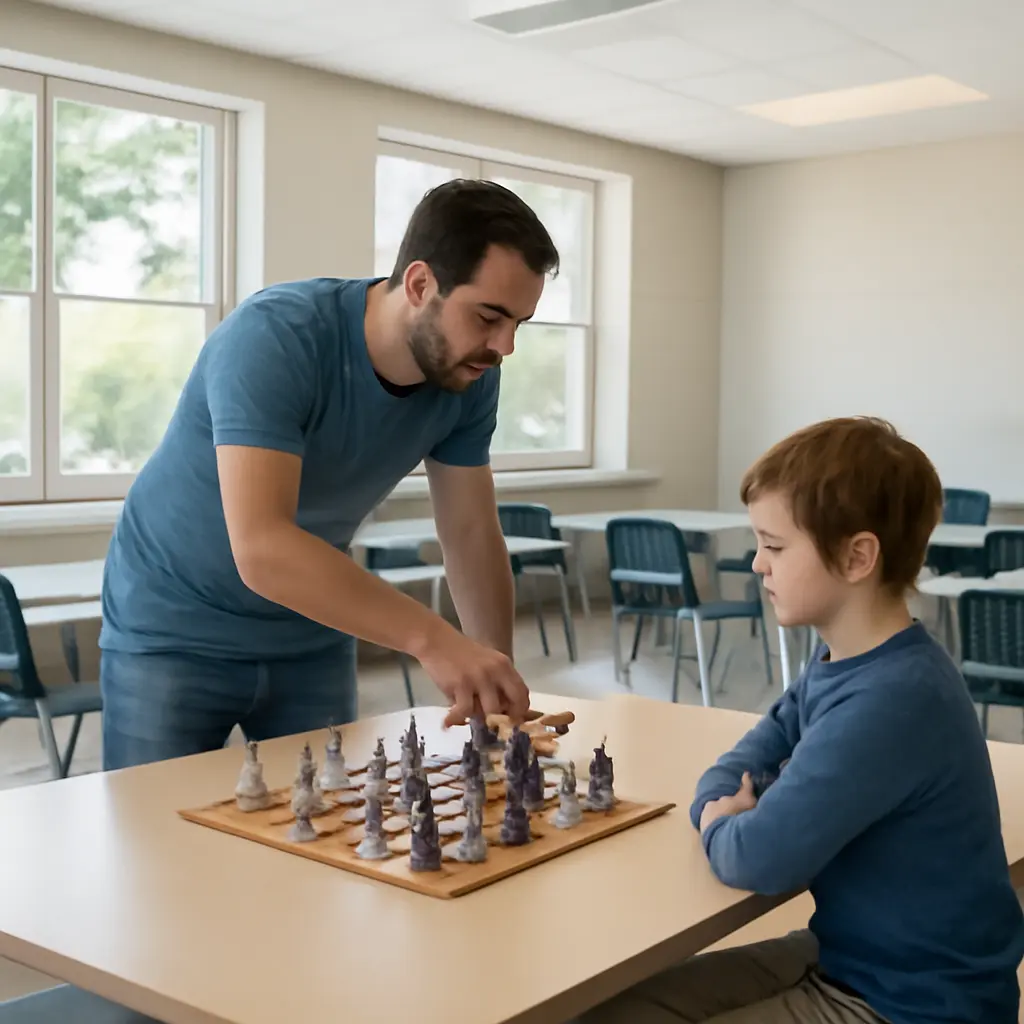
Teaching my nephew chess in one afternoon showed me how much can stick when the lesson focuses on a few useful ideas rather than every rule at once. Chess is a two-player strategy game played on a 64-square board, and its basic rules can be introduced quickly; developing skill, of course, takes much longer. What my nephew remembered best was how the pieces move, why protecting the king matters, and how to pause before making a move. Those takeaways echo the beginner principles taught by organizations such as the U.S. Chess Federation, while research on learning offers a useful reminder: brief instruction can build a starting framework, but practice is what makes knowledge durable.
Chess basics made a one-afternoon lesson work
A beginner chess lesson is a short introduction to the board, pieces, legal moves, and the goal of checkmate. It is not a promise that a child will master strategy in a few hours. My aim was simpler: help my nephew start a game, recognize what the pieces could do, and enjoy thinking through a position.
That modest goal matters because chess has a compact rule set but a vast number of possible positions. The game begins with 16 pieces per player on an 8-by-8 board. The U.S. Chess Federation’s beginner resources emphasize learning the pieces and the objective before taking on deeper strategy. Instead of presenting every special case at once, I taught the rules in layers and used each new idea immediately on the board.
The board and pieces came first
Chess is played on 64 alternating light and dark squares. Each side begins with a king, a queen, two rooks, two bishops, two knights, and eight pawns. I had my nephew place the pieces before explaining them, turning the starting position into a simple memory exercise rather than a lecture.
We learned movement with a few quick demonstrations: rooks travel in straight lines, bishops move diagonally, queens combine those paths, and knights move in an L-shape and can jump over pieces. Pawns move forward but capture diagonally. The king moves one square at a time. Those core patterns gave him enough to make legal moves and recognize why each piece behaves differently.
The goal was checkmate, not capturing everything
Checkmate occurs when a king is under attack and has no legal way to escape. This definition shifts a beginner’s attention from collecting pieces to pursuing the actual objective. I explained that a player should not leave their own king in check and that a threatened king must be protected, moved, or the attacking piece dealt with.
This was the first idea that changed how my nephew looked at the board. Before that, he treated a capture as the obvious purpose of every move. Once he understood checkmate, he began asking whether a move helped his king, threatened mine, or simply gave away a piece.
Chess habits my nephew remembered after the lesson
Knowing how pieces move is only the foundation. The ideas that make a beginner’s next game less confusing are practical habits: develop pieces, keep the king safe, notice threats, and consider the opponent’s reply. These are not guarantees of winning; they are manageable questions that help turn a random move into a reasoned one.
Develop pieces and make room to play
Development means bringing pieces from their starting squares to useful positions, usually toward the center of the board. The center matters because pieces placed there can often influence more squares. I showed my nephew how moving a knight or bishop early could help prepare the rest of his pieces to join the game.
The idea is more useful than a rigid opening recipe for a first-time player. Rather than memorizing a named opening, he could remember to bring pieces out, avoid moving the same piece repeatedly without a reason, and make sure the queen was not sent on a risky solo adventure.
Protect the king and recognize check
King safety means reducing the chance that the opponent can attack the king successfully. Castling is a special move that can help by moving the king toward a safer position and bringing a rook into play, provided the required conditions are met. I introduced castling as a useful rule to learn after the basic piece movements, not as something he had to memorize before playing.
The more memorable lesson was that a player must respond when their king is in check. We practiced finding three kinds of response: move the king, block the attack when possible, or capture the attacking piece if that is legal. A few simple examples helped him see that threats can demand an immediate answer.
Pause and look for the opponent’s threat
A blunder is a serious mistake that may lose material or allow a decisive attack. To reduce careless errors, I gave my nephew one repeatable prompt: “What can my opponent do next?” That question encouraged him to scan for threatened pieces and checks before committing to a move.
The habit also helped make the game feel less like a race. He began noticing that a move could look attractive but leave a rook undefended, or that an opponent’s piece might be attacking his king. In a beginner lesson, this kind of pause is more practical than asking a child to calculate a long sequence several moves ahead.
Why a short chess lesson needs practice afterward
A one-afternoon introduction can create familiarity, but it cannot establish mastery. Learning research summarized by the Institute of Education Sciences recommends practices such as spacing study over time and using quizzes to strengthen recall. For chess, that translates naturally into short follow-up games, asking the learner to explain a move, and revisiting one rule at a time.
Short games turn rules into decisions
A complete game gives a beginner a reason to use the rules rather than repeat them from memory. We played slowly and paused whenever a confusing position appeared. I asked him to identify which pieces were under attack and what each player seemed to be trying to do.
That approach also kept mistakes from becoming discouraging. When he moved a piece illegally, we corrected the move and continued. When he missed a threat, we looked at the position together. The objective was not to protect him from losing; it was to make each mistake explain something he could use next time.
A simple routine helps the lesson stick
A useful next step is a brief routine repeated across several days. The learner can name a piece’s movement, play a short game, and review one position where a threat was missed. The U.S. Chess Federation’s educational materials and beginner guides from established chess organizations can provide further structured exercises as confidence grows.
- Start by setting up the board correctly.
- Play one short game or a small tactical exercise.
- Ask, “Is my king safe, and what is my opponent threatening?”
- Review one mistake without trying to analyze the entire game.
These steps are deliberately modest. A repeatable routine is easier to sustain than a long session, and it gives the child a clear way to see progress: fewer forgotten rules, more defended pieces, and better explanations for chosen moves.
What stayed with him after one afternoon of chess
My nephew did not leave as a chess expert. He left knowing how the pieces move, that checkmate—not capturing every piece—is the goal, and that it pays to look for the opponent’s threat before moving. Those are small lessons, but they gave him enough confidence to start another game and enough curiosity to ask what he had missed.
That is the useful measure of a first chess lesson: not how many rules fit into one afternoon, but whether the learner can use a few ideas and wants to keep playing. If you are teaching a beginner, start with the board, demonstrate the pieces, play a short game, and return to the same key questions next time. A little practice after the lesson is what gives those first ideas room to stick.
Sources: U.S. Chess Federation, Learn to Play Chess, https://new.uschess.org/learn; U.S. Chess Federation, Chess in Education, https://new.uschess.org/chess-education; Institute of Education Sciences, Organizing Instruction and Study to Improve Student Learning, https://ies.ed.gov/ncee/wwc/PracticeGuide/1.