
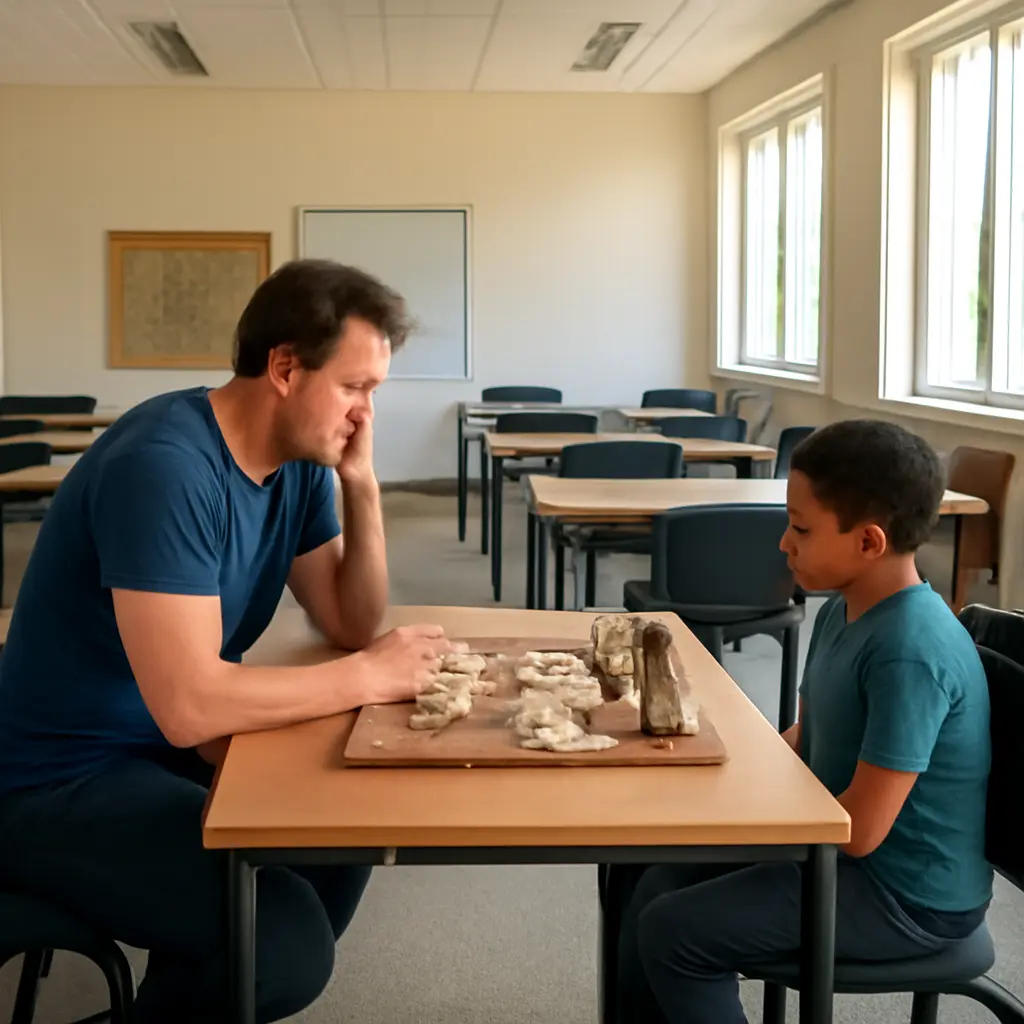
Coaches of young chess players often see focus not as a matter of staring harder at the board, but as a trainable ability to direct attention, manage emotion, and make a sound decision under pressure. Research on attention and child development supports that practical view: children’s executive skills are still developing, and chess creates repeated opportunities to practise planning, impulse control, and reflection. The lesson is not that chess automatically improves every child’s general intelligence; it is that coaches can make concentration more reliable by shaping the task, the environment, and the player’s routines.
Focus and the chessboard: how coaches build attention in young players
How coaches define focus in young chess players
In practical coaching, focus is the ability to keep attention on information relevant to the position, resist distractions and impulses, and return to the task after attention wanders. It is not simply sustained eye contact with the board. A child can look at the pieces while mentally replaying a mistake; another can briefly glance away, then return with a clear plan.
This working definition aligns with the Center on the Developing Child at Harvard University’s account of executive function: a group of mental processes that support working memory, flexible thinking, and self-control. Those abilities develop through childhood and adolescence rather than appearing fully formed. For chess coaches, that means attention should be taught through manageable routines, not demanded as a fixed trait.
Sustained attention: staying with the position
Sustained attention is the capacity to remain engaged with a task over time. In chess, it means continuing to examine the position after the obvious move has been found—especially when the game becomes quiet or difficult. Coaches can support it by using short, purposeful exercises, gradually extending their duration, and giving young players a clear question to answer, such as “What is my opponent threatening?”
The American Academy of Pediatrics’ clinical guidance on media use notes that children’s ability to regulate attention and behavior changes with age and context. It does not establish a universal attention span for every child. Accordingly, coaches should avoid treating a single time limit as a developmental law: fatigue, age, task difficulty, and a player’s experience all affect how long useful concentration lasts.
Selective attention: finding the details that matter
Selective attention is the ability to prioritize relevant cues over distractions. On a chessboard, important cues may include an undefended piece, a king with fewer defenders, a forcing check, or a change in the opponent’s plan. Beginners often scan randomly; coaches help them develop a consistent search order, such as checking threats, captures, and checks before choosing a move.
This does not mean that every position can be solved with a mechanical checklist. The checklist is a guardrail that helps a young player notice critical features before intuition takes over. As experience grows, children learn which patterns deserve attention and which apparent threats are harmless.
Inhibitory control: pausing before a move
Inhibitory control is the capacity to stop an immediate response long enough to consider alternatives. In chess, it is the pause between seeing a tempting move and touching a piece. Coaches often teach this with a simple routine: identify the opponent’s last move, name the threat, generate candidate moves, and check the chosen move for a tactical reply.
The routine matters because impulsive moves are not always caused by lack of knowledge. Excitement, time pressure, or frustration can make a player act before checking. A brief pause turns self-control into an observable skill that can be practised and praised.
How coaches turn focus into board habits
Once focus is understood as a set of related skills, coaching can connect it to repeatable board habits. These habits bridge attention and decision-making: the player first notices the position, then considers options, and finally reviews the choice. The aim is not to eliminate mistakes, but to make thinking more deliberate and recoverable.
A pre-move scan: threats, options, and blunders
A pre-move scan is a short sequence of checks before committing to a move. A useful youth version asks: What changed after my opponent’s move? What is threatened? What are my candidate moves? What can the opponent do in reply? This translates broad advice to “pay attention” into concrete actions a coach can observe.
The International Chess Federation’s Laws of Chess make a distinction between considering a move and making a move: once a player deliberately touches a piece with the intention of moving it, the touch-move rule may apply. That tournament rule gives coaches a practical reason to teach players to finish their scan before touching a piece, while also helping them avoid rushed decisions in casual games.
Working memory and candidate moves
Working memory is the ability to keep information active while using it. A young player may need to remember the opponent’s threat, compare two candidate moves, and imagine a reply—all before moving a piece. Coaches can reduce unnecessary cognitive load by asking one question at a time and using positions with a clear learning objective rather than overwhelming beginners with many competing ideas.
A 2011 meta-analysis by Giovanni Sala and Fernand Gobet examined chess instruction and academic or cognitive outcomes. It found positive average effects in the studies reviewed, but also highlighted limitations in the research, including study quality and the difficulty of separating chess instruction from other factors. The careful conclusion is that chess practice can provide structured opportunities to use planning and working memory; the evidence does not justify promising that chess lessons will automatically raise every child’s performance in unrelated subjects.
Emotional regulation after mistakes
Emotional regulation is the ability to notice a feeling and keep it from taking over the next decision. After a blunder, a child may become angry, embarrassed, or eager to win the material back immediately. Coaches can normalize mistakes, use a brief reset—breathe, sit back, and identify the current position—and postpone analysis until the player is ready to learn from it.
The American Psychological Association describes stress as a response that can affect attention and decision-making. In a game, the practical implication is that a young player who is upset may need help returning to the present position before receiving technical instruction. A calm reset is not an excuse for poor play; it is a way to restore the conditions needed for thoughtful play.
How practice conditions shape concentration
Board habits work best when the practice setting supports them. Coaches therefore consider not only what a child should think about, but also the length, difficulty, and emotional tone of the activity. This connects individual attention skills to the wider design of lessons and games.
Short exercises and gradual progression
A focused exercise has one clear goal: for example, finding a defensive move, identifying a hanging piece, or calculating a short forcing line. Coaches can begin with a few minutes of demanding work, discuss the reasoning, and increase complexity as the child becomes more comfortable. The exact duration should be adjusted to the player rather than presented as a universal scientific threshold.
The National Association for the Education of Young Children emphasizes developmentally appropriate practice: instruction should respond to children’s age, individual differences, and context. Applied to chess, this means that a young beginner may learn more from a brief, interactive puzzle session than from a long lecture about opening theory.
Feedback that rewards process, not just results
Process feedback recognizes useful thinking behaviors—checking the opponent’s threat, comparing candidate moves, or recovering calmly—rather than praising only a win. This helps children understand what they can control. A coach might say, “You paused and checked the reply before moving,” even when the final move was imperfect.
A well-known study by Claudia Mueller and Carol Dweck found that children praised for intelligence responded differently to setbacks than children praised for effort in the experimental tasks. The research was not a chess study, so it should not be treated as direct proof about tournament performance. It does, however, support a coaching principle: praise specific strategies and effortful learning rather than making ability seem fixed.
Time controls, fatigue, and the digital environment
Time controls change the kind of attention a game demands. Longer games allow more deliberate calculation but can be tiring; blitz encourages rapid pattern recognition while leaving less time for a full scan. Coaches should match the format to the lesson objective and help children notice when fatigue or clock pressure is causing careless decisions.
Digital tools can offer convenient puzzles and rapid feedback, but notifications, rapid-fire play, and switching between tasks can compete with sustained thought. The American Academy of Pediatrics recommends considering the quality and context of children’s media use rather than relying on a single screen-time number. For chess practice, a quiet board session and a carefully chosen digital exercise can complement each other when each has a defined purpose.
What the evidence says—and what it does not
The case for teaching focus through chess rests on two different kinds of evidence. Developmental research explains why attention, working memory, and self-control benefit from scaffolding. Chess studies examine whether learning the game transfers to broader outcomes. The first supports thoughtful coaching practice; the second is more mixed and should be described cautiously.
Sala and Gobet’s 2016 review of chess instruction and academic performance reported positive findings across a number of studies, while emphasizing methodological challenges and the need for stronger research. Results can depend on the age of participants, how chess is taught, comparison groups, and whether benefits persist beyond the training setting. Coaches should therefore present chess as a rich setting for practising disciplined thought—not as a guaranteed shortcut to higher grades, improved attention in every context, or a diagnosis or treatment for attention difficulties.
A useful way to summarize the evidence is to separate near transfer from far transfer. Near transfer means getting better at related chess tasks, such as spotting familiar tactical patterns. Far transfer means a broad improvement in an unrelated domain, such as general school achievement. Chess instruction plainly gives players direct practice in chess; claims about far transfer require stronger evidence and should not be assumed from enthusiasm or anecdote alone.
Conclusion: focus is coached, not demanded
Young players’ focus combines sustained attention, selective attention, working memory, impulse control, and emotional regulation. Coaches help these capacities grow by teaching a pre-move scan, breaking complex thinking into manageable steps, providing process-focused feedback, and choosing practice conditions that fit the child. Research supports the importance of these developing skills, while evidence for broad academic transfer from chess remains qualified.
For parents and coaches, the next step is practical: choose one thinking routine, practise it consistently, and praise the child for using it—even when the game is lost. A board can be a place to learn more than moves, provided adults treat concentration as a skill to develop rather than a test of character.
Sources: Center on the Developing Child at Harvard University, “Executive Function & Self-Regulation,” https://developingchild.harvard.edu/science/key-concepts/executive-function/; American Academy of Pediatrics, “Media and Children,” https://www.aap.org/en/patient-care/media-and-children/; International Chess Federation, FIDE Handbook, Laws of Chess, https://handbook.fide.com/chapter/E012023; Sala, Giovanni, and Fernand Gobet, “Do the Benefits of Chess Instruction Transfer to Academic and Cognitive Skills? A Meta-Analysis,” Educational Research Review, 2011, https://doi.org/10.1016/j.edurev.2011.04.002; American Psychological Association, “Stress Effects on the Body,” https://www.apa.org/topics/stress/body; National Association for the Education of Young Children, “Developmentally Appropriate Practice,” https://www.naeyc.org/resources/position-statements/dap; Mueller, Claudia M., and Carol S. Dweck, “Praise for Intelligence Can Undermine Children’s Motivation and Performance,” Journal of Personality and Social Psychology, 1998, https://doi.org/10.1037/0022-3514.75.1.33; Sala, Giovanni, and Fernand Gobet, “Do the Benefits of Chess Instruction Transfer to Academic and Cognitive Skills? A Systematic Review and Meta-Analysis,” Educational Research Review, 2016, https://doi.org/10.1016/j.edurev.2016.02.002.