
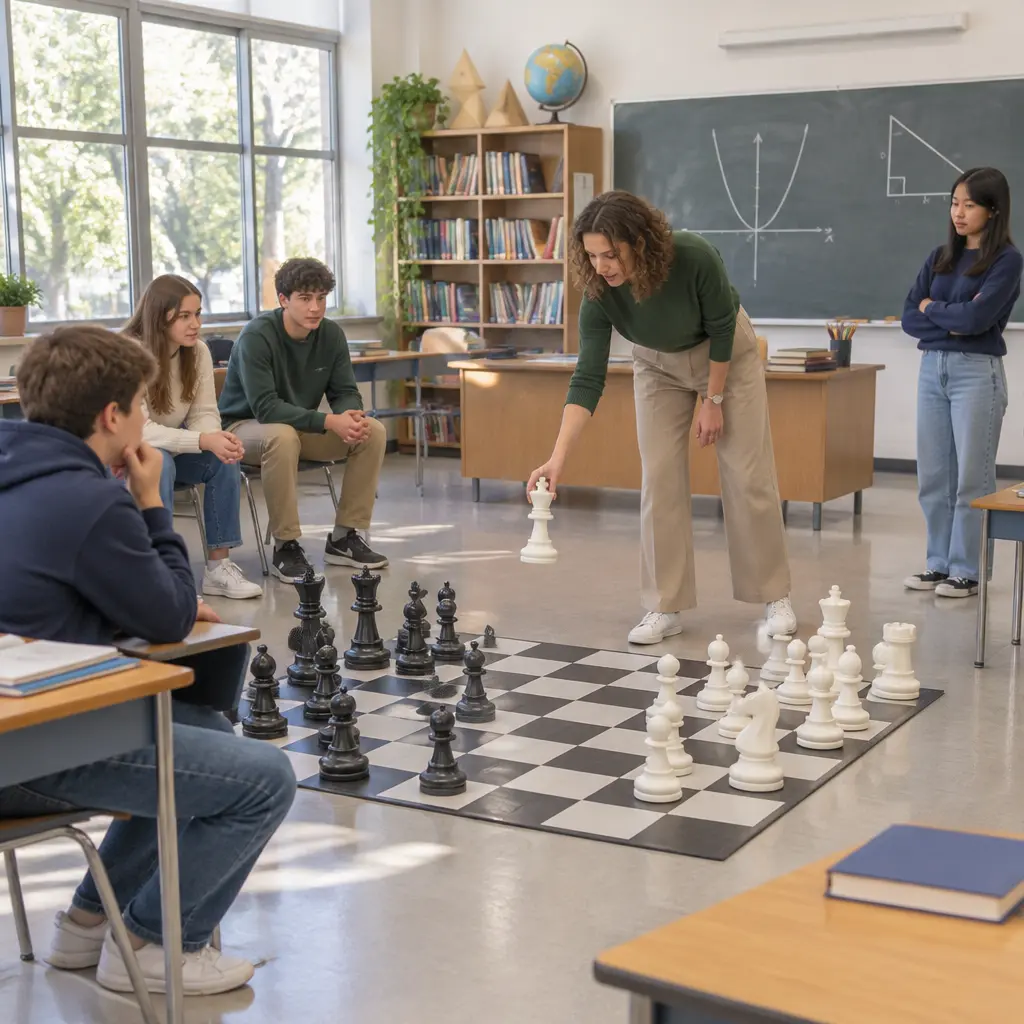
Chess-integrated math instruction uses the rules, positions, and strategic decisions of chess as contexts for teaching standard mathematical ideas—not as a replacement for the math curriculum. In practical classroom models, teachers connect chess to counting, coordinates, geometry, patterns, measurement, and problem-solving, then assess learning against ordinary grade-level objectives. The approach is promising because chess creates visible, rule-governed problems for students to reason about, but evidence does not justify treating chess alone as a guaranteed way to raise math achievement. This article defines the instructional model, compares classroom designs, explains how to align activities with mathematics standards, and outlines assessment, implementation, and research considerations.
Chess-Integrated Math Instruction: Definition and Evidence
A classroom integration model is a planned way of connecting learning activities from one domain to the objectives, teaching sequence, and assessment of another. In this case, chess is the context and mathematical learning is the intended outcome. The National Council of Teachers of Mathematics (NCTM) describes effective mathematics teaching as supporting students’ reasoning, problem-solving, discourse, and connections among mathematical ideas. A chess-based lesson fits that principle when students must explain mathematics—not merely play a game.
Chess offers concrete mathematical features: an 8-by-8 board has 64 squares; files and ranks create a coordinate grid; pieces move according to precise constraints; and positions invite counting, classification, spatial visualization, and comparison. These features make chess a flexible teaching context, but the presence of a board does not itself establish that students have learned the targeted mathematics. The teacher must identify the objective, elicit mathematical reasoning, and check understanding independently of game performance.
Research is encouraging but should be interpreted carefully. Sala and Gobet’s 2016 meta-analysis of educational chess studies reported positive average effects on mathematics and cognitive outcomes, while also noting limitations in the quality and design of the underlying evidence. A prominent 2016 evaluation of the English Chess in Schools programme by Jerrim and colleagues found no clear overall improvement in mathematics or cognitive ability attributable to the intervention. Together, these findings support piloting and measuring well-aligned lessons rather than promising automatic achievement gains.
Models of Chess-Integrated Math Instruction
The main models differ in how much time chess receives and how directly it is tied to a math objective. A useful distinction is between chess as a brief instructional representation, chess as a recurring problem-solving context, and chess as an extended interdisciplinary unit. These are practical design categories rather than a single research-validated taxonomy.
Chess as a short mathematical representation
In a representation model, the teacher uses a board or piece to make an existing concept visible. Students might locate a square by its file and rank, trace a rook’s horizontal and vertical movement, or count possible destinations under specified conditions. The activity is brief and serves a clear objective, such as ordered pairs, lines, or systematic counting. This model is especially practical when curriculum time is limited because it can fit within a standard lesson without requiring students to learn full chess strategy.
Chess puzzles as mathematical problem-solving
In a puzzle model, students analyze a position under explicit constraints and explain why a proposed solution works. They may enumerate legal moves, compare routes, identify a pattern, or justify that a position meets a condition. The mathematical value comes from making assumptions explicit, testing cases, and communicating a reasoned conclusion. Teachers should distinguish a chess solution from a mathematical proof: students need to state the relevant rules and show how their reasoning supports the answer.
Recurring chess-and-math stations
A station model uses short, repeatable tasks across several lessons. One station might ask students to plot positions; another might compare piece values or calculate totals; a third might challenge students to count routes or classify moves. Station rotations can support mixed-readiness groups, provided each task has a defined math target and an accessible entry point. The National Council of Teachers of Mathematics emphasizes meaningful mathematical discourse and purposeful use of representations; student explanations at stations help make the mathematical thinking visible.
Interdisciplinary chess-and-math units
An extended unit combines several objectives, such as coordinates, transformations, measurement, and data analysis, with chess history, notation, or tournament records. Students could map moves, build scale models of boards, collect game data, and compare frequencies. This model can deepen connections but requires careful scope: the unit must still provide enough direct instruction and practice for each required math standard. Chess enrichment should not displace essential curriculum content unless the lesson demonstrably teaches that content.
Mathematical Concepts Supported by Chess
Once teachers select a model, they can match chess features to specific concepts. The strongest matches are those where the board, rules, or positions naturally represent the mathematics being taught. The examples below are adaptable across grades, but standards and vocabulary should be adjusted to local curriculum expectations.
Coordinates, ordered pairs, and spatial reasoning
The chessboard provides an 8-by-8 grid, with files labeled a through h and ranks numbered 1 through 8. Students can name locations such as e4, translate between chess notation and ordered-pair conventions, and describe changes in position. Because coordinate conventions differ—chess notation places the file letter before the rank number, while many Cartesian systems write the horizontal value first—teachers should explicitly compare the systems rather than assume they are interchangeable. Tasks can progress from locating a square to describing a move as a change in coordinates.
Counting, patterns, and systematic enumeration
Chess positions invite students to count legal moves, classify destinations, and search for repeated structure. For example, students can investigate how a knight’s available moves change near the center and edges of the board, recording results in a table and explaining the pattern. A lesson can connect this investigation to organized counting and the importance of defining conditions. Results depend on the piece’s location and on whether other pieces block or occupy squares, so the teacher should specify the position precisely.
Geometry, transformations, and measurement
Board layouts support work with rows, columns, diagonals, symmetry, and geometric movement. Students can compare the path of a bishop with that of a rook, identify lines of symmetry in a position, or examine how a board pattern changes under reflection or rotation. If a physical board is used for measurement, students can measure square dimensions and calculate the board’s side length or area. The board is a model, however: a chess move is governed by game rules, while a geometric transformation is defined mathematically, so the two should be connected with care.
Arithmetic, ratios, and data analysis
Teachers can create arithmetic tasks using explicitly assigned piece values, compare the total material in two positions, or analyze class-generated game data. Piece values are strategic conventions, not fixed mathematical truths; any numerical scale should be labeled as a classroom model. For statistics, students might tally how often different pieces move in a set of short games, calculate fractions or percentages, and represent results in a bar graph. A small classroom sample illustrates data practices but should not be presented as evidence about chess in general.
Lesson Design, Assessment, and Inclusion
A sound lesson begins with the math outcome and then selects the chess feature that best serves it. This sequence avoids a common mismatch: an engaging game is introduced, but students spend most of the period learning rules rather than practicing the intended mathematics. The following design steps keep the activity aligned and assessable.
Start with a measurable learning objective
Write an objective that describes observable mathematical performance, such as “Students will represent a chessboard position using ordered pairs and explain how a move changes the coordinates.” Identify prerequisite knowledge, vocabulary, and likely misconceptions. Then choose a board task that requires the target skill. The objective should remain assessable even for a student who is not yet fluent in chess strategy.
Use a gradual lesson sequence
A practical sequence is to introduce the math question, model the relevant board representation, let students solve a constrained task, and close with explanation and transfer. For example, after modeling file-and-rank notation, students can locate teacher-selected squares, record a piece’s legal destinations, and then solve a coordinate task on a conventional grid. The final transfer step checks whether students understand the mathematics beyond the chess setting.
Assess mathematical understanding separately from chess skill
Assessment should capture the targeted mathematics through worked examples, exit tickets, oral explanations, or a short rubric. A student may reason accurately about coordinates without knowing advanced chess tactics; another may play well without explaining the math. Separating these measures prevents chess familiarity from being mistaken for mathematical mastery. Teachers can compare pre- and post-lesson responses, but a short classroom check should be described as local evidence, not proof of long-term impact.
Make participation accessible and equitable
Chess experience, language background, disability, and access to equipment can affect participation. Teachers can provide large-print or tactile boards, digital or paper alternatives, simplified positions, vocabulary supports, and partner roles that rotate between moving pieces, recording coordinates, and explaining reasoning. Offer a noncompetitive option when the objective is mathematical, and avoid assigning permanent roles based on perceived ability. These supports align with Universal Design for Learning principles promoted by CAST: provide multiple means of engagement, representation, and action or expression.
Implementation Examples and Evidence Limits
A simple classroom example is a coordinate-and-movement investigation. Students receive a board diagram with a knight on a specified square, mark every legal destination, record each destination in notation, and compare the number of moves with a knight placed near a corner. They then explain why board location changes the count. The teacher assesses coordinate accuracy, systematic enumeration, and explanation—not who finds the answer first.
A second example uses a class data set. Students play or analyze a small number of simplified games, tally selected piece movements, and represent the counts in a graph. They discuss what the data show and what they cannot show, including the limited sample size and the influence of game conditions. This makes the activity useful for data literacy without implying that the class results generalize to all chess play.
Published evidence should guide expectations. Sala and Gobet’s meta-analysis found positive average effects across the studies it reviewed, but educational interventions and study designs varied. The English Chess in Schools evaluation by Jerrim and colleagues is an important counterweight because it did not find clear overall gains in mathematics or cognitive ability. Differences in program intensity, implementation, comparison groups, and outcome measures make results difficult to reduce to a single claim. Schools should therefore track participation and curriculum-based learning outcomes, and seek stronger comparison designs when making claims about effectiveness.
Conclusion: Building Math Lessons Around Chess Logic
Chess-integrated math instruction is most defensible when it is treated as a purposeful teaching model: chess supplies a structured context, while mathematics remains the learning goal. Short representations, puzzle-based reasoning, recurring stations, and interdisciplinary units can connect chess to coordinates, counting, geometry, arithmetic, and data analysis. Effective implementation starts with measurable objectives, preserves time for explanation and transfer, assesses math separately from playing skill, and includes accessible ways to participate.
Research provides reasons to explore the approach, not grounds for guaranteeing achievement gains. Teachers and school leaders can begin with a small, standards-aligned pilot, document student work, compare learning against the stated objectives, and adjust activities based on evidence. For further reading, consult NCTM’s guidance on effective mathematics teaching, CAST’s Universal Design for Learning framework, and the published studies by Sala and Gobet and by Jerrim and colleagues.
Sources: National Council of Teachers of Mathematics, Principles to Actions: Ensuring Mathematical Success for All, https://www.nctm.org/Store/Products/Principles-to-Actions–Ensuring-Mathematical-Success-for-All/; Sala, Giovanni, and Fernand Gobet, “Do the Benefits of Chess Instruction Transfer to Academic and Cognitive Skills? A Meta-Analysis,” Educational Research Review, 2016, https://doi.org/10.1016/j.edurev.2016.02.002; Jerrim, John, et al., “The Chess in Schools Trial: Game of Chance or Game of Skill?,” Educational Research, 2016, https://doi.org/10.1080/00131881.2016.1168873; CAST, Universal Design for Learning Guidelines, https://udlguidelines.cast.org/.