
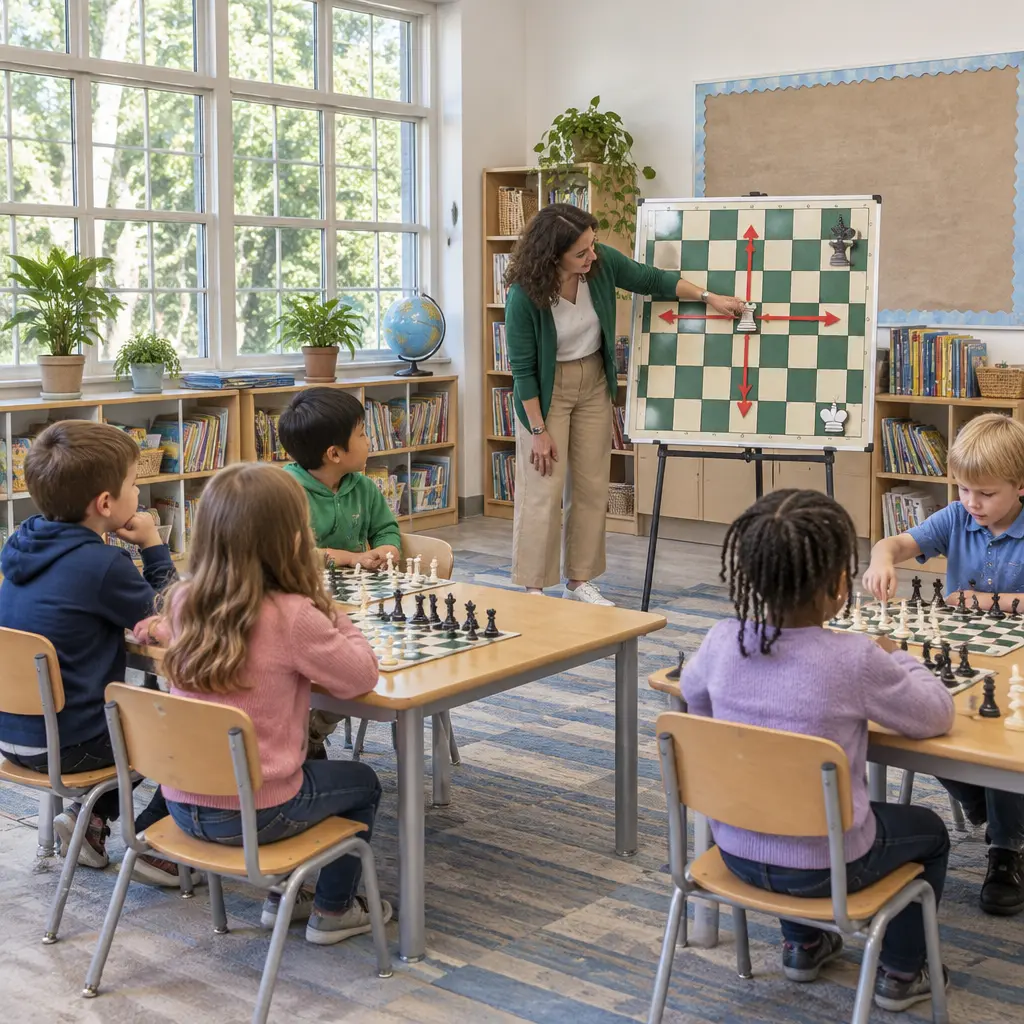
Second-grade chess readiness means helping children learn and enjoy chess through short, concrete, age-appropriate experiences—not expecting them to follow adult tournament routines from the start. For many seven- and eight-year-olds, readiness is better judged by curiosity, willingness to take turns, and ability to try one simple idea than by mastery of every rule. The American Academy of Pediatrics describes ages six to eight as a period of growing attention, cooperation, and rule understanding, while emphasizing that children develop at different rates. Instruction can therefore build from brief games, visual demonstrations, and guided practice toward legal moves, check, and full games, with progress measured by participation and understanding rather than speed or competitive results.
Age-Appropriate Chess Readiness Supports Second-Grade Learning
Chess readiness is the combination of interest, foundational knowledge, and learning conditions that lets a child participate meaningfully in chess. It is not a fixed developmental label or a requirement that every second grader sit still for a long lesson. The U.S. Centers for Disease Control and Prevention notes that children aged six to eight are developing longer attention, greater independence, and stronger social skills, but these are broad developmental patterns, not promises about any individual child.
The distinction matters because chess asks children to coordinate several demands at once: remember how pieces move, scan a changing board, wait for a turn, and cope with wins or mistakes. The American Academy of Pediatrics’ guidance on school-age development supports expectations that grow gradually. A useful readiness plan introduces one manageable concept at a time, then observes whether the child can use it with support.
Readiness is participation, not adult-level performance
For a beginner, readiness may look like naming a piece, moving it correctly after a demonstration, or staying engaged through a short partner activity. Children do not need to memorize notation, calculate long variations, or play a complete game without reminders before they can benefit from instruction. These are later skills, and they may arrive at different times.
The National Association for the Education of Young Children recommends developmentally appropriate practice: educators should account for common developmental patterns as well as each child’s individual strengths, experience, and context. Applied to chess, that means offering a beginner task and an optional challenge rather than treating one pace as the standard for the whole class.
A practical measure: engagement and one observable skill
Teachers can check readiness by noticing whether a student can follow a short demonstration, take a turn with a reminder, and explain or show one idea. A child who loses focus during a long explanation may still learn well through a quick board puzzle or a movement activity. This is a practical instructional check, not a clinical attention assessment.
A simple progress record can note three things after each session: the concept introduced, the support needed, and one example of successful use. For example: “Rook moves in straight lines; used a floor-board demonstration; found a clear path in one of two puzzles.” Such notes help an instructor adjust the next lesson without turning chess into a test.
Short Chess Lessons Match Developing Attention and Memory
Attention-friendly chess instruction breaks learning into short cycles of explanation, action, and review. There is no single research-established “correct” chess lesson length for every second grader. Instead, teachers can begin with brief activities and adapt based on visible engagement, transitions, and the group’s needs. This approach connects chess teaching with broader evidence on active learning and manageable cognitive load.
Use compact lesson cycles
A useful starting format is a five- to eight-minute demonstration followed by a short activity, then a reset or recap. The exact timing is a teaching choice, not a universal developmental statistic. A 25-minute session, for instance, might include a quick warm-up, one new idea, a partner task, and a final “show me” question rather than 25 minutes of uninterrupted talk.
The Institute of Education Sciences’ What Works Clearinghouse practice guides emphasize that learning improves when instruction includes clear modeling, guided practice, and feedback. In chess, a teacher can model one move aloud, invite students to identify a legal move, and then let them try it on their own boards. Short cycles also make it easier to spot confusion before it spreads.
Reduce memory demands with visual and physical cues
Working memory is the limited mental space used to hold and manipulate information while completing a task. Beginners can be overloaded if they must remember every piece’s movement, the board’s orientation, turn-taking rules, and a strategic goal all at once. Keep the board visible, introduce one movement pattern at a time, and use a consistent prompt such as “Where can this piece travel?”
Concrete representations help bridge explanation and practice. A large demonstration board, colored arrows, floor squares, or a small number of pieces can make abstract movement rules easier to inspect. After students understand a piece in isolation, they can try it in a simplified position before facing a full board.
Build transitions and movement into the lesson
A planned change of activity can refresh attention without abandoning the learning goal. Students might stand on a floor grid to trace a rook’s route, point to a knight’s possible landing squares, or switch roles as “player” and “piece-movement coach.” Movement should remain purposeful and safe, especially when children share a classroom or club space.
The Centers for Disease Control and Prevention’s school physical-activity guidance recognizes classroom activity breaks as one way to support movement during the school day. A chess movement break is not a substitute for broader physical activity, but it can connect a chess concept to an active reset. If students return more ready to focus, the teacher can keep the format; if not, the activity should be adjusted.
Beginner Chess Skills Should Progress from Concrete to Complex
A beginner progression moves from recognizing the board and pieces to making legal moves, noticing threats, and eventually playing a full game. This sequence is a teaching framework rather than a strict age-based timetable. Children may already know some rules from home, while others need repeated practice with the board’s layout before they are ready for strategy.
Start with board orientation and piece movement
Board orientation means setting up the board correctly and recognizing how squares and pieces relate to one another. Teach one piece at a time with a clear visual example. Students can first identify a piece, trace its legal routes, and then select a destination square. This sequence separates recognition from decision-making, making it easier to see which part needs practice.
The U.S. Chess Federation’s beginner materials present the rules and movement of individual pieces as foundational knowledge. Teachers can use that foundation in age-appropriate ways: a rook-only “race,” a bishop path-finding challenge, or a knight-jump puzzle with just a few pieces. These simplified games preserve the movement rule while reducing the number of competing choices.
Teach checks and captures through visible examples
A check is an attack on the king that must be answered; a capture removes an opposing piece from the board. Both concepts can feel abstract when introduced only through verbal definitions. Set up a position in which one piece clearly attacks another, ask students to point to the threatened piece, and then let them consider a small number of possible responses.
Avoid teaching several special cases at once. Once students can recognize ordinary moves and a basic check, introduce additional rules such as castling or en passant when they become relevant. The goal is not to hide the full rules but to sequence them so that new information connects to something the child can already demonstrate.
Introduce strategy as one-question thinking
Early strategy can be framed as a single question before a move: “Is one of my pieces in danger?” or “What can my opponent do next?” This encourages attention to consequences without requiring advanced calculation. A teacher can model the question aloud, give students a few seconds to look, and invite more than one reasonable answer.
The National Council of Teachers of Mathematics’ problem-solving principles are relevant here: students benefit when they explain their thinking, compare approaches, and learn from errors. A chess move can become a small reasoning task when the child is asked to describe why it seems useful—not merely whether it wins.
Play Formats Make Chess More Accessible to Second Graders
Chess can be taught through multiple formats, including mini-games, cooperative puzzles, partner practice, and complete games. These are complementary options, not competing versions of “real chess.” Varying the format gives children repeated practice while controlling how many rules, pieces, and social demands they must manage at one time.
Mini-games isolate one learning target
A mini-game uses a reduced board or limited set of pieces to focus on one concept. For example, students might practice moving only rooks toward a goal square or help a king avoid a single attacking piece. These activities shorten decision time and provide more repetitions of the target skill than a full game may offer.
Mini-games are especially useful when a student knows a movement rule but struggles to apply it amid a crowded position. Keep the win condition simple, explain it before play, and stop briefly to let students describe what they noticed. If the game becomes confusing, remove pieces or model the next turn rather than repeating a long explanation.
Cooperative puzzles reduce early competitive pressure
A cooperative puzzle asks students to solve a chess position together rather than defeat one another. The group might find a safe square for a king, identify all legal moves for a piece, or discover how to protect a threatened unit. Shared problem-solving allows children to hear different ideas and practice chess vocabulary without every activity becoming a contest.
Cooperative work also gives a teacher a chance to model respectful disagreement: “Show us the square you mean,” or “Let’s test both ideas.” This supports the social purpose of a chess club alongside the game itself. Students should still have opportunities for friendly competition when they are ready and interested.
Use complete games when the rules are manageable
A complete game is appropriate when students can make basic legal moves and understand whose turn it is, with reminders as needed. For early games, provide a visible rule card, allow pauses, and treat the result as secondary to trying the skills being learned. A teacher may also use a shorter playing period or agree that the game ends after a learning target is reached.
The U.S. Chess Federation’s official rules are designed for organized play, where consistent procedures matter. A classroom introduction has a different purpose: to teach those procedures gradually while maintaining a welcoming atmosphere. Explain that tournament rules exist, but do not make tournament formality the price of joining a beginner lesson.
Inclusive Chess Instruction Adapts to Individual Differences
Inclusive chess instruction offers more than one way to receive information, participate, and show understanding. A second-grade classroom may include children who read at different levels, are learning English, have disabilities, or simply prefer different learning approaches. Providing clear routines and flexible supports benefits the group without assuming that every child needs the same accommodation.
Make instructions accessible and repeatable
Use short verbal directions paired with a demonstration and a visible cue. Instead of explaining an entire game before students touch the pieces, give one instruction, let them try it, and check for understanding. Chess vocabulary can be posted with a picture or piece symbol so students can refer to it during play.
CAST’s Universal Design for Learning framework recommends providing multiple means of engagement, representation, and action or expression. In practice, a child might show understanding by moving a piece, pointing to a legal square, explaining aloud, or matching a picture to a rule. These options preserve the learning goal while reducing unnecessary barriers.
Offer predictable routines and supportive choices
A predictable routine can include the same opening puzzle, a posted activity sequence, and a clear signal for switching partners or putting pieces away. Children may also benefit from bounded choices, such as selecting a rook challenge or a bishop challenge. Choice supports autonomy while keeping the lesson focused.
For a student who finds a full board visually crowded, begin with fewer pieces or use a board with high contrast. For a student who benefits from extra time, reduce the number of positions rather than rushing turns. Coordinate individual accommodations with the child’s family and school support team where appropriate; chess activities should complement, not replace, established educational plans.
Teach emotional resilience alongside rules
Chess creates moments of uncertainty: a child may overlook a piece, lose a game, or change their mind. Normalize mistakes as information by asking, “What did the board show?” or “What would you try next time?” This keeps feedback specific and helps separate a game outcome from a child’s sense of competence.
The Collaborative for Academic, Social, and Emotional Learning identifies self-management and relationship skills among core social-emotional competencies. Chess lessons can provide practice in waiting, communicating, and handling frustration, but these benefits should not be promised as automatic outcomes. Adults shape the experience through fair pairing, encouraging feedback, and a clear expectation of respectful play.
A Classroom Case Example Shows How to Adapt the Lesson
Consider a second-grade club with students who know different amounts about chess. One child recognizes every piece but rushes; another is new to the board; a third understands movement but disengages during long explanations. A single lecture followed by full games is likely to serve them unevenly. A differentiated session can keep a shared goal while adjusting the route each student takes.
Example: a 25-minute rook lesson
The instructor begins with a two-minute “find the rook” warm-up, then demonstrates that rooks move in straight lines. Students trace routes on a large board before working in pairs on a rook-only mini-game. A short midway reset gives students a chance to stand, stretch, and name one legal rook move. The final minutes are used for a quick puzzle and a verbal or visual exit check.
Students who need more support can use arrows or a less crowded board. Students who understand the basic movement can solve a challenge that includes a blocked path. The instructor records whether each child can identify a legal rook move and what support helped. This is an illustrative teaching example, not a published controlled study or a claim that one lesson duration works for all children.
How to know whether the adaptation worked
Success can be assessed through observable evidence: more students take a turn, fewer need the movement rule repeated, or children can show a legal route in a new position. If most students remain confused, the next lesson should revisit the concept with fewer pieces or a clearer demonstration. If students finish quickly and accurately, offer a harder route-finding puzzle rather than adding several new rules at once.
This approach reflects formative assessment: teachers use evidence during learning to decide what to teach next. The U.S. Department of Education’s Institute of Education Sciences describes assessment as useful when it informs instructional decisions. In a chess club, a brief demonstration or exit question may provide more actionable information than a formal score.
Conclusion: Keep Second-Grade Chess Curious, Short, and Flexible
Second-grade chess readiness is best understood as the ability to participate and learn with suitable support, not as compliance with adult standards. Short lesson cycles, concrete demonstrations, a gradual skills progression, and varied play formats help children practice without carrying too much information at once. Inclusive routines and emotionally supportive feedback make it easier for students with different experience and learning needs to take part.
For a practical next step, choose one chess concept, prepare a brief demonstration and a simple activity, and decide in advance what students will do to show understanding. Observe how the group responds, then adjust the timing, materials, or challenge level. Teachers and families can also consult the U.S. Chess Federation’s beginner resources, CAST’s Universal Design for Learning guidance, and school-age development materials from the CDC and American Academy of Pediatrics.
Sources: Centers for Disease Control and Prevention, Child Development: Middle Childhood (6–8 years), https://www.cdc.gov/child-development/positive-parenting-tips/middle-childhood-6-8-years.html; American Academy of Pediatrics, Healthy Children: Developmental Milestones—6 to 8 Year Olds, https://www.healthychildren.org/English/ages-stages/gradeschool/Pages/Developmental-Milestones-6-to-8-Year-Olds.aspx; National Association for the Education of Young Children, Developmentally Appropriate Practice, https://www.naeyc.org/resources/position-statements/dap/contents; Institute of Education Sciences, Organizing Instruction and Study to Improve Student Learning, https://ies.ed.gov/ncee/wwc/PracticeGuide/1; Centers for Disease Control and Prevention, Strategies for Classroom Physical Activity in Schools, https://www.cdc.gov/healthyschools/physicalactivity/classroom-pa.htm; U.S. Chess Federation, Rules of Chess, https://new.uschess.org/rules; National Council of Teachers of Mathematics, Principles to Actions: Ensuring Mathematical Success for All, https://www.nctm.org/Store/Products/Principles-to-Actions–Ensuring-Mathematical-Success-for-All/; CAST, Universal Design for Learning Guidelines, https://udlguidelines.cast.org/; Collaborative for Academic, Social, and Emotional Learning, What Is the CASEL Framework?, https://casel.org/fundamentals-of-sel/what-is-the-casel-framework/; Institute of Education Sciences, Formative Assessment, https://ies.ed.gov/ncee/wwc/PracticeGuide/18