
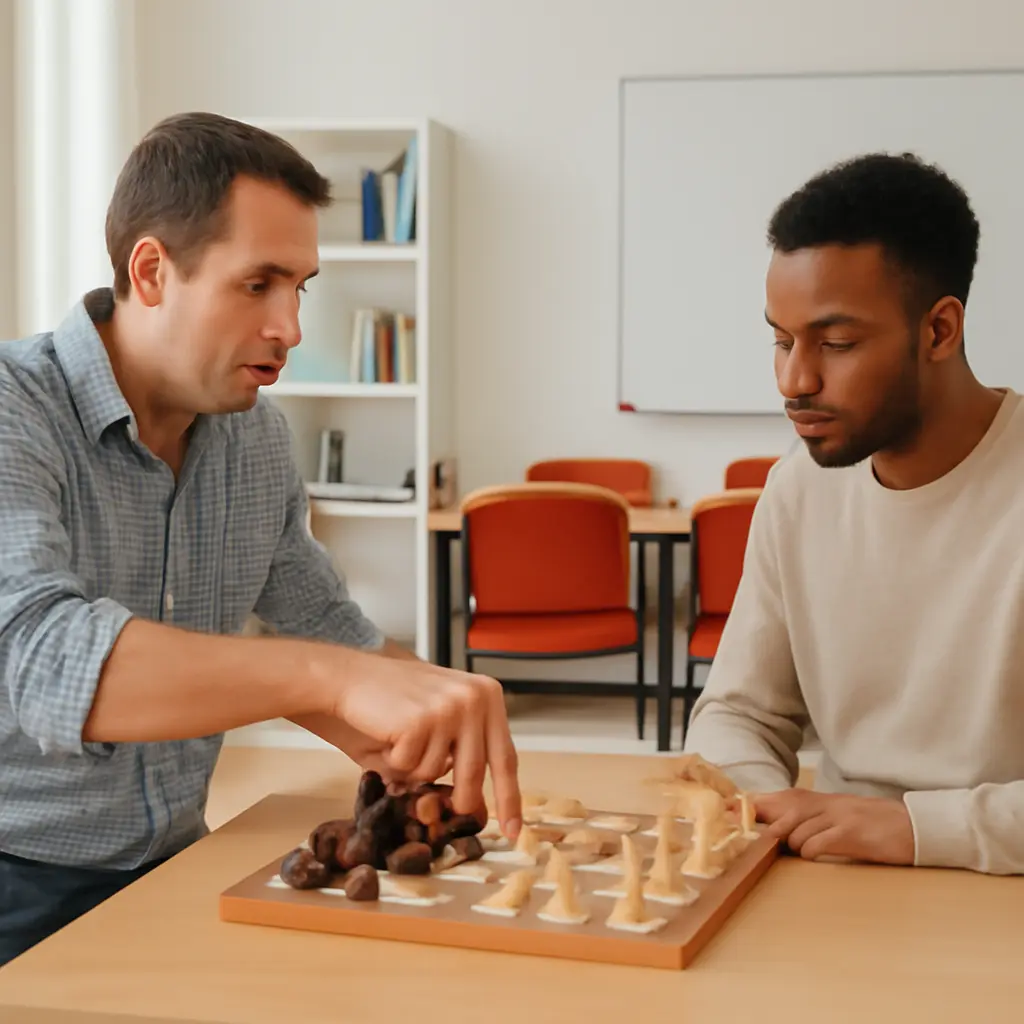
Teaching absolute beginners who have never touched a chessboard means helping them learn the board, pieces, and basic rules before asking them to play a full game. The most effective approach is gradual, hands-on, and encouraging: begin with board orientation and piece movement, then introduce simple goals and short practice games. This matters because chess has many interacting rules—FIDE’s Laws of Chess cover everything from legal moves to checkmate and draws—so trying to teach them all at once can overwhelm a first-time learner. A clear progression, frequent demonstrations, and small successes make the game easier to enter and give beginners a foundation for learning independently.
Teaching absolute beginners: the first-learning sequence
An absolute beginner is someone with no prior practical experience of a chessboard or its rules. There is no single research-backed lesson plan that guarantees success for every learner, so teachers should treat the sequence below as a flexible teaching framework rather than a proven formula. The central principle is to introduce one new idea at a time, demonstrate it on the board, and let the learner try it immediately.
Start with the board and its orientation
The chessboard has 64 squares arranged in eight rows and eight columns, alternating light and dark. Before placing pieces, have the learner position the board so that the corner square on their right is light—often remembered as “light on the right.” Then point out that files run vertically and are named a through h, while ranks run horizontally and are numbered 1 through 8. FIDE’s Laws of Chess use this coordinate system to describe squares and moves, but a first lesson can focus on recognizing the board’s pattern and orientation without requiring notation mastery.
Set up the pieces with a repeatable pattern
Each player begins with 16 pieces: one king, one queen, two rooks, two bishops, two knights, and eight pawns. Teach the back row as a pattern: rooks in the corners, knights beside them, bishops next, and the queen on a square matching her color; the king occupies the remaining square. Pawns fill the row immediately in front. Ask the learner to set up one side, then check it together before adding the other side. This turns setup into a practical memory task rather than a list to memorize.
Teaching absolute beginners: piece movement and basic rules
Once the board is familiar, teach movement through demonstration and short exercises. The International Chess Federation (FIDE) defines legal play through its Laws of Chess; for a beginner, the essential idea is that players take turns moving one piece at a time, and a move must follow that piece’s movement rules. Introduce captures as moves that remove an opponent’s piece from its square, while emphasizing that pieces generally cannot move through other pieces—except the knight, which can jump.
Teach one piece at a time
Use an otherwise empty board and ask the learner to show where a piece can move. Begin with the rook’s straight lines, then the bishop’s diagonals, and the queen’s combination of those directions. The king moves one square in any direction, while the knight moves in an L-shaped pattern and can jump over intervening pieces. Pawns move forward, usually one square at a time, but capture one square diagonally forward; from their starting squares, they may move two squares if the path is clear. These descriptions summarize ordinary movement, not every special rule.
Keep the first drills simple: place a piece on a central square and have the learner identify its legal destinations, then add a friendly piece as an obstacle. Avoid introducing all pieces in a single explanation. A learner who can reliably show how a rook moves has achieved a useful milestone, even if they are not yet ready to play a complete game.
Explain check, checkmate, and special moves in stages
Check means the king is under attack. The player in check must make a legal move that removes the attack; checkmate occurs when the king is in check and no legal move can do so. These ideas explain the game’s central objective: to checkmate the opponent’s king, not to capture it. Castling, en passant, and pawn promotion are also part of standard chess, but they are easier to understand after learners can move pieces and recognize check. FIDE’s Laws specify the conditions for these special moves, so consult the current rules when teaching their details.
Teaching absolute beginners: practice, confidence, and feedback
Knowing the rules and using them during a game are different tasks. Short, focused activities help beginners connect a rule to a decision without requiring them to manage a whole board at once. The World Chess Federation’s Chess in Education materials describe chess as an educational activity used in varied learning settings; however, claims about broad academic benefits should be treated carefully, because outcomes depend on the program, learners, and study design.
Use mini-games before a full game
A mini-game limits the number of pieces or the objective so the learner can focus on one concept. For example, a rook-and-pawn exercise can practice straight-line movement and captures, while a “find a safe square” activity can reinforce how pieces attack. Another simple drill is to take turns placing a single piece on an empty board and naming its legal moves. These are teaching examples rather than official chess formats; adapt them to the learner’s age, attention span, and confidence.
Give feedback that supports learning
When a beginner makes an illegal move, pause and ask what rule they are applying. If needed, demonstrate the movement again and invite them to correct the move themselves. Praise accurate thinking—such as noticing that a square is blocked—not only winning or capturing a piece. Keep early games unrated and low-pressure. If the learner becomes frustrated, return to a short movement drill or finish with a position they can solve successfully.
A practical first-lesson plan
A first session can be organized into short stages, with time adjusted to the learner rather than treated as a fixed research-validated prescription:
- Orient the board and identify its rows, columns, and colors.
- Set up the pieces together and name each piece.
- Demonstrate the movement of two or three pieces, then let the learner practice each one.
- Introduce captures and the idea that pieces can block one another.
- Show check and the goal of checkmate, then play a short, simplified game or position.
- Review one thing the learner understood and one idea to practice next time.
Conclusion: make the first chess experience inviting
Teaching someone who has never touched a chessboard begins with orientation and setup, continues through piece movement and basic rules, and develops through mini-games and supportive feedback. FIDE’s rules provide the authoritative framework for legal play, while a beginner-friendly lesson breaks that framework into manageable discoveries. Start with the board, demonstrate rather than lecture, postpone special rules until they are relevant, and let the learner practice each new concept. For further reading, use FIDE’s Laws of Chess for rule details and the World Chess Federation’s educational materials for ideas about chess learning in classrooms and other settings.
Sources: Fédération Internationale des Échecs (FIDE), FIDE Laws of Chess taking effect from 1 January 2023, https://handbook.fide.com/chapter/E012023; International Chess Federation (FIDE), Chess in Education, https://edu.fide.com/