
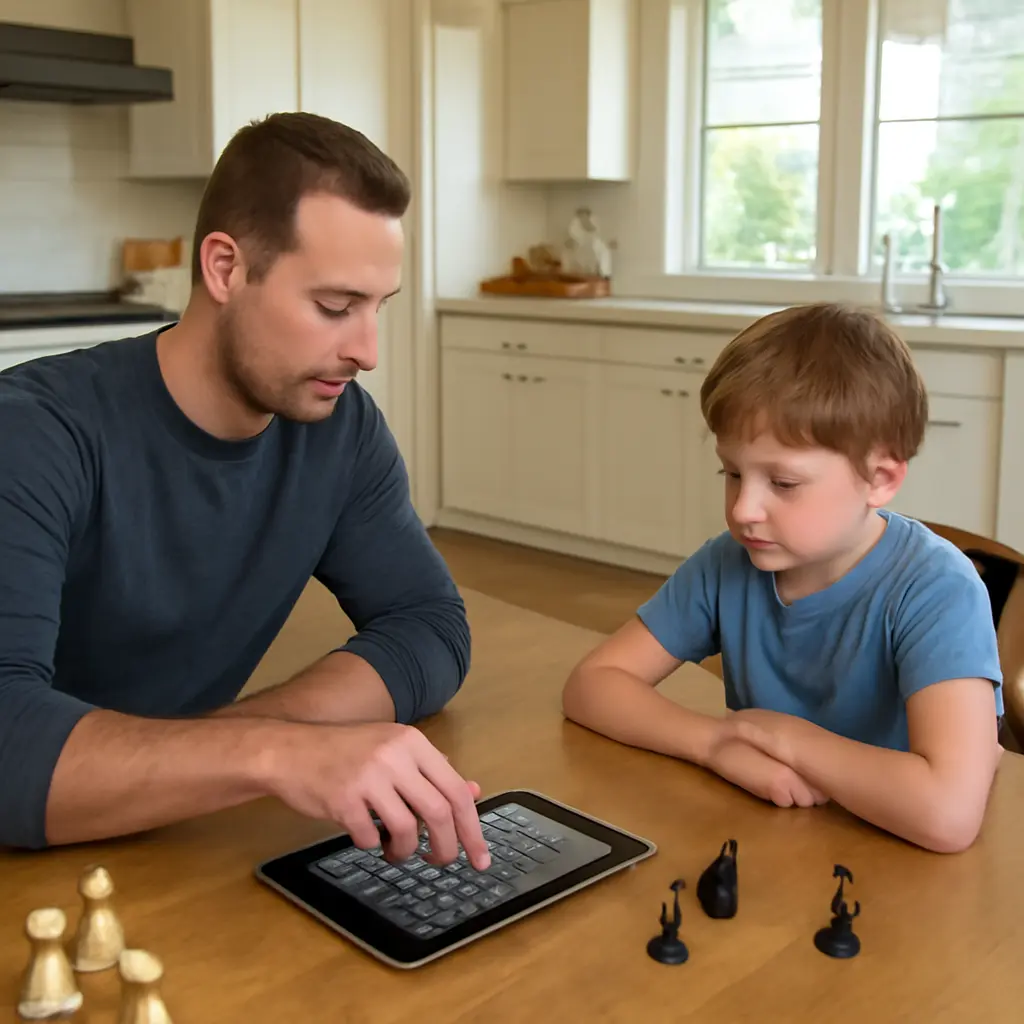
Online chess with a child is a shared learning activity in which a parent and child use a digital board or lesson platform to practice the game together. The best way to begin without losing patience is to keep sessions short, teach one idea at a time, choose a child-friendly platform, and treat mistakes as useful information rather than failures. That approach fits what research says about children’s attention and learning: the American Academy of Pediatrics recommends limits and routines around recreational screen use, while chess studies suggest possible academic benefits but do not justify turning every game into a test. Below are practical ways to set expectations, choose tools, teach fundamentals, manage frustration, and build a routine that can last.
Online chess practice: what parents should know
Online chess practice is a structured, screen-based opportunity to learn the rules, make decisions, and play with another person. It can mean a parent-child game, a guided lesson, a puzzle, or a supervised match against a computer. The key distinction is that “online” describes the delivery method; it does not automatically make the activity educational, safe, or enjoyable. A child benefits most when an adult provides a calm purpose and appropriate boundaries.
Chess is also a game of repeated decisions and consequences. A child can learn how a move changes the position immediately, which makes the board useful for practicing attention, planning, and coping with setbacks. A 2016 meta-analysis in the journal Educational Research Review examined 24 studies and reported positive average effects of chess instruction on mathematics and cognitive outcomes. The authors also noted limitations in the evidence, including variation in study quality and design. Parents should therefore offer chess as an engaging activity, not promise that it will automatically raise grades or intelligence.
A good first session needs little more than a shared board, a clear stopping point, and permission to learn slowly. The practical goal is not to finish a full game; it is to end with the child still willing to play again.
A patient teaching approach for online chess
A patient teaching approach means guiding a child with manageable challenges, supportive feedback, and room to make decisions. The American Psychological Association’s work on learning and motivation emphasizes the value of feedback that helps learners understand what to do next. Applied to chess, that means replacing “That was a bad move” with a specific question such as, “Which of your pieces could your opponent capture?”
For a beginner, the most useful teaching categories are the rules, simple tactical patterns, and good habits during play. These concepts are related, but they should not all be introduced at once. First establish that the child understands how pieces move; then practice noticing threats; later, add planning and review.
Rules and board familiarity
Board familiarity is the ability to recognize the board’s layout, identify pieces, and understand legal moves. The World Chess Federation, known as FIDE, publishes the Laws of Chess, which define the official rules, including how each piece moves and how a game ends. A young learner does not need to memorize every tournament rule before playing. Begin with piece movement, check, checkmate, and the goal of protecting the king.
Use a digital board’s highlights or legal-move hints as scaffolding, not as a shortcut to rush through the lesson. Ask the child to name a piece and show one legal move. If that is difficult, return to one piece at a time. A short “piece safari”—finding all the knights, then showing how one moves—can be more inviting than a lecture on the entire rulebook.
Tactics and one-move puzzles
A chess tactic is a short sequence in which a player uses a feature of the position to win material, give checkmate, or gain another concrete advantage. Beginners often start with simple patterns such as spotting an undefended piece, giving a safe check, or finding a capture. Online puzzles can provide immediate feedback, but the parent should resist turning each wrong answer into a rapid-fire correction.
Try a “think, point, explain” routine: let the child pause, point to a candidate move, and say what they expect it to do. One puzzle is enough if it creates a useful conversation. The goal is to develop the habit of looking at the whole board before moving, not to maximize a daily puzzle score.
Planning and reflection
Planning is choosing a move with a simple purpose, such as developing a piece, protecting a king, or challenging an opponent’s threat. Reflection is a brief review of what happened and what the player might try next time. For a child, one question after a game—“Which move are you proud of?”—can be more constructive than replaying every mistake.
Keep the review proportionate to the child’s age and energy. If the game ended in frustration, take a break before discussing it. A useful review makes the child feel more capable; it does not require the parent to identify every missed opportunity.
Choosing a child-friendly online chess setup
A child-friendly setup is one that makes the game easy to follow while giving adults appropriate control over time, contact, and content. Platforms differ in account requirements, chat settings, advertisements, lesson features, and parental controls, so check their current terms and settings before creating an account. Do not assume that a popular site is automatically suitable for every child.
Select the simplest useful features
For early lessons, prioritize a clear board, readable pieces, legal-move guidance, and the option to play privately with a parent. Puzzles and lessons can help once the child knows the basics, but a crowded interface may distract from the board. If a feature creates pressure to chase ratings or streaks, turn it off or choose a different activity.
For younger children, a shared device and an adult-created session may be simpler than an independent account. Review whether the platform permits private games, limits direct messages, and allows chat to be disabled. These are practical safety checks, not claims that any one service is universally safe.
Set screen and privacy boundaries
Screen boundaries are predictable rules for when, where, and how long a child uses a device. The American Academy of Pediatrics recommends creating a family media plan that considers the child’s age, sleep, schoolwork, physical activity, and family routines. Its guidance is not a chess-specific time limit; parents should choose a session length that fits their child and the rest of the day.
For privacy, use a screen name that does not reveal the child’s full name, school, location, or other identifying details. Keep games private when possible, disable unnecessary chat, and supervise interactions with other players. If a platform’s controls or data practices are unclear, choose a simpler option that allows parent-child play without public matchmaking.
Keeping online chess calm and enjoyable
A calm chess session depends less on the child’s ability and more on the adult’s expectations. Children may lose focus, repeat a mistake, or want to stop early. Those are cues to adjust the activity, not evidence that the child is being difficult or incapable.
Use short sessions and clear goals
A short session has a defined beginning and end, with one achievable goal. For example: “We’ll practice how bishops move, then play one mini-game.” Start with 10 to 15 minutes as a practical trial, not a scientifically fixed prescription, and shorten it if the child becomes tired or restless. End while the experience is still positive rather than waiting for attention to collapse.
If a full game takes too long, play a mini-game with fewer pieces or practice a single position. The format should serve the learner. It is perfectly reasonable to stop after one good discovery rather than insist on reaching checkmate.
Praise effort, choices, and recovery
Helpful praise describes a controllable action: “You checked whether your knight was safe,” or “You took a breath and found another move.” This gives the child information about what to repeat. Avoid praising only wins or natural talent, since a beginner cannot control every outcome in a game against a stronger player.
When the child makes a mistake, pause before explaining. Ask, “What were you trying to do?” or “What might your opponent do next?” If the child is upset, acknowledge the feeling and take a break. A calm reset protects the relationship and makes future learning more likely.
Make losing safe and ordinary
A beginner-friendly game makes losing a normal part of practice, rather than a verdict on ability. Parents can model this by naming their own errors without self-criticism: “I missed that threat; now I see it.” Consider using a handicap, cooperative puzzle, or shared analysis where parent and child solve a position together.
If competition repeatedly causes tears or arguments, temporarily remove the result. Take turns finding a good move for either side, or set a shared goal such as developing all the minor pieces. The point is to keep chess associated with curiosity and connection.
A practical first-month routine
A first-month routine is a flexible sequence for building familiarity without overloading a new player. It can be adapted to age, experience, and interest; there is no requirement to follow a formal curriculum.
- In the first session, explore the board and practice how each piece moves.
- In the next few sessions, focus on one idea at a time: checking the king, protecting pieces, or noticing captures.
- Introduce short games or mini-games, with an adult nearby and no pressure to finish every match.
- After a game, discuss one enjoyable moment and one thing to try next time.
- At the end of the month, ask the child what they want more of—puzzles, games, or learning piece movement—and adjust accordingly.
For example, a parent whose child becomes upset after losing can replace rated matches with a cooperative “find the safest move” challenge. Another family might use a weekly parent-child game as a routine, stopping after 15 minutes whether or not the game is complete. These small changes put the child’s experience ahead of the platform’s scoring system.
Conclusion: make chess a shared practice, not a test
Online chess with a child works best when the rules are introduced gradually, the platform is chosen with privacy and supervision in mind, and each session has a modest goal. Short practice, specific encouragement, and calm responses to mistakes help a child learn without making every move feel consequential. Research offers reasons to value chess as a thinking activity, but the strongest immediate benefit may be the shared time and the chance to practice patience together.
Start with one short session this week: choose a private, simple board, practice one piece or idea, and stop while both of you still want another game. For further guidance, consult FIDE’s Laws of Chess for official rules and the American Academy of Pediatrics’ family media resources for age-appropriate screen planning.
Sources: Sala, Giovanni and Fernand Gobet, “Do the benefits of chess instruction transfer to academic and cognitive skills? A meta-analysis,” Educational Research Review, 2016, https://doi.org/10.1016/j.edurev.2016.02.002; World Chess Federation (FIDE), Laws of Chess, https://handbook.fide.com/chapter/E012023; American Academy of Pediatrics, Family Media Plan, https://www.healthychildren.org/English/fmp/Pages/MediaPlan.aspx; American Psychological Association, “How to give feedback that helps students learn,” https://www.apa.org/education-career/k12/feedback