
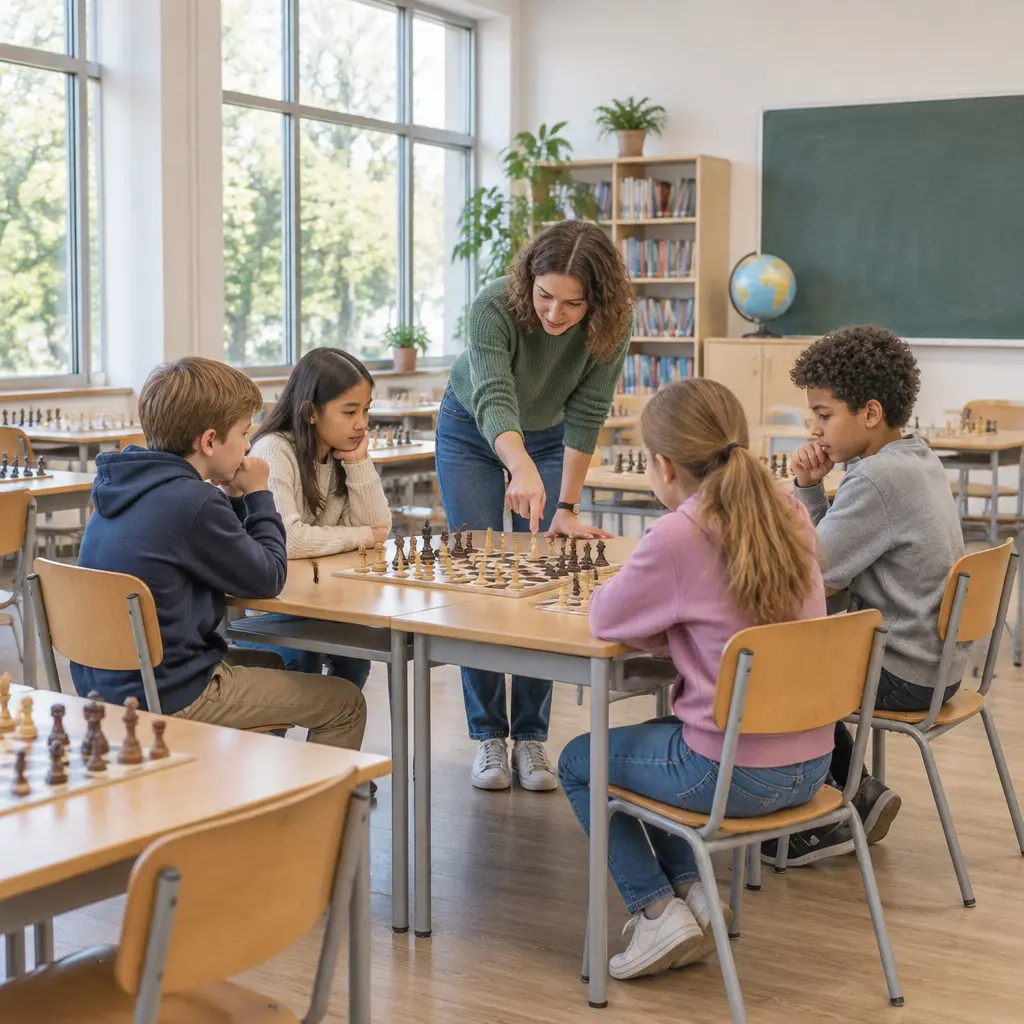
Teacher training models for chess equip non-chess educators to facilitate learning without requiring them to become chess experts. A strong model starts with facilitation skills—such as asking productive questions, guiding discussion, and creating an inclusive learning environment—then adds enough chess knowledge and ready-to-use materials to support play. This approach matters because chess programs often operate in schools where classroom teachers, rather than specialist instructors, lead activities. The World Economic Forum’s review of research on chess education describes potential links with skills such as problem-solving, while also noting that outcomes depend on how instruction is designed and implemented. Training should therefore prepare educators to teach through chess, not simply teach chess moves.
Facilitation-first training defines the teacher training model
A facilitation-first teacher training model prepares educators to organize meaningful chess experiences by combining practical game knowledge with learner-centered teaching skills. The model distinguishes between knowing how to play and knowing how to help learners think: the educator need not be a tournament player, but should understand basic rules, common positions, and how to guide students as they make and explain decisions.
This distinction is consistent with the National Research Council’s account of effective learning, which emphasizes connecting new knowledge to prior understanding, making thinking visible, and using assessment to guide instruction. In a chess lesson, that can mean asking a student to explain why a move protects a piece instead of immediately supplying the “right” move. The board becomes a shared object for reasoning, dialogue, and reflection.
Facilitation competence
Facilitation competence is the ability to structure participation and support learners’ thinking without taking over the task. It includes establishing routines, posing open questions, listening for reasoning, managing turn-taking, and responding to mistakes as opportunities to learn. These skills are transferable from classroom teaching: an educator can invite students to compare two candidate moves, explain a pattern, or test a prediction even while developing personal chess fluency.
The Institute of Education Sciences’ practice guides recommend active engagement, feedback, and opportunities to explain ideas as components of effective instruction in relevant subject areas. For chess facilitation, those practices can be made concrete through brief demonstrations followed by student analysis, paired play, and a short debrief. The measure of success is not how many positions the teacher explains, but whether students can articulate and examine their own choices.
Chess-content competence
Chess-content competence is the minimum reliable knowledge needed to run a safe, accurate, and purposeful activity. It usually covers board setup, legal movement, check and checkmate, castling, pawn promotion, en passant, draw conditions, and basic notation or vocabulary. Training can sequence these topics so educators first master the rules that arise most often in beginner games, then consult concise references for less frequent situations.
This is a bounded expertise model rather than a claim that chess knowledge is unnecessary. Teachers must be able to identify uncertainty and verify a rule instead of improvising an answer. A useful program provides a rules card, model games, worked examples, and a pathway for contacting a chess mentor. It also distinguishes between rules knowledge and coaching expertise: beginner facilitation does not require advanced opening preparation or tournament-level analysis.
Program hyponyms: models within the broader approach
Several specific training models fall under the facilitation-first approach:
-
Train-the-trainer: a lead instructor prepares school staff, who then run recurring sessions with shared lesson materials.
-
Co-teaching: a chess specialist models instruction while the classroom educator practices facilitation, gradually taking more responsibility.
-
Peer-supported learning: educators learn alongside students or colleagues, using a facilitator guide and an agreed method for resolving rules questions.
-
Blended professional learning: short workshops are paired with video demonstrations, printable lesson plans, and follow-up coaching.
These models share a design principle: training is more useful when it continues into practice. The next step is to decide what professional learning should contain and how educators can apply it in a real classroom.
Professional learning builds the teacher training model
Professional learning is the structured process through which educators develop, rehearse, and refine the knowledge and routines needed to facilitate chess. The Learning Policy Institute’s review of effective teacher professional development identifies features including active learning, collaboration, models of practice, coaching, feedback, and sustained duration. These features are relevant to chess training because a one-time rules presentation rarely gives a novice teacher enough opportunity to practice responding to real student questions.
Workshop and rehearsal
A workshop introduces core rules and facilitation moves, while rehearsal lets educators practice them before working with students. Participants might take turns leading a five-minute mini-lesson, ask a partner to justify a move, and rehearse how to respond when two learners disagree about a rule. This reduces the gap between knowing a technique and being able to use it under classroom conditions.
The National Council on Teacher Quality and teacher-development researchers commonly emphasize practice-based preparation, including modeling and opportunities to rehearse instructional techniques. A chess workshop can apply that principle with microteaching: one participant leads a short activity, peers use a simple observation checklist, and the facilitator gives specific feedback on clarity, questioning, and student participation.
Coaching and communities of practice
Coaching provides individualized support after initial training, while a community of practice enables educators to exchange lesson ideas and solve recurring problems together. A coach may observe a session, model a question sequence, or help a teacher adapt a game for mixed ages. Colleagues can share solutions for common issues such as uneven playing strength, disputes over rules, or students finishing at different times.
The Learning Policy Institute’s synthesis reports that effective professional development is typically sustained rather than confined to a single event. Schools can translate that principle into a modest support cycle: a launch workshop, a short check-in after the first few sessions, and periodic review of student work or lesson reflections. The aim is practical improvement, not adding a burdensome evaluation system.
Ready-to-use lesson resources
A facilitator guide turns training into repeatable classroom practice. It should include lesson aims, materials, timings, diagrams, suggested questions, common misconceptions, adaptations, and a brief reflection prompt. For example, a lesson on protecting pieces might ask learners to identify an attacked piece, propose two responses, and explain the trade-off between moving and defending it.
Resources should reduce cognitive load without scripting every interaction. Clear routines—how to set up boards, rotate partners, pause a game, and reset pieces—leave more teacher attention available for listening and inclusion. A one-page rules reference also helps educators acknowledge uncertainty transparently and check the answer with students rather than presenting a guess as fact.
Inclusive classroom practice applies the teacher training model
Inclusive classroom practice adapts chess activities so learners with different experience levels, languages, abilities, and confidence can participate meaningfully. Chess offers a common visual task, but access is not automatic: unfamiliar notation, fast play, competitive norms, or limited equipment can create barriers. Facilitation training should therefore include ways to vary the task while preserving its reasoning objective.
Differentiation and accessible participation
Differentiation means adjusting support, challenge, or the way learners demonstrate understanding. Beginners might use a reduced-piece game or solve one-move puzzles; experienced players might analyze multiple candidate moves or explain a plan. Learners can also describe a position verbally, point to a square, use a large demonstration board, or work with a partner when writing notation is a barrier.
The U.S. Department of Education’s National Center for Education Statistics reports persistent differences in educational opportunity and achievement across student groups, underscoring why accessible design matters across classroom activities. Those national measures do not establish chess-specific effects, but they reinforce a general implementation point: programs should check who participates, who receives instructional attention, and whether equipment and lesson formats are usable by all students.
Social-emotional learning and fair play
Social-emotional learning in chess involves practicing patience, managing frustration, respecting an opponent, and reflecting on decisions. These outcomes are not guaranteed by playing a game; they depend on how adults establish norms and respond to winning, losing, and mistakes. A facilitator can model respectful analysis by asking, “What did you learn from that position?” rather than treating a loss as a personal failure.
The Collaborative for Academic, Social, and Emotional Learning identifies competencies such as self-management, social awareness, and relationship skills. Chess activities can offer situations in which learners practice these capacities, but teachers should describe them as opportunities for practice rather than proven outcomes of chess alone. Reflection prompts and consistent fair-play routines make the intended behaviors explicit.
Classroom management and safe competition
Classroom management for chess includes predictable transitions, clear noise expectations, fair pairing, and a plan for students who finish early. A teacher may use timed rounds, rotating partners, puzzle stations, or a quiet analysis task to keep participation purposeful. Competition should be optional or carefully structured, especially when students have sharply different experience levels.
A facilitation-first model treats the emotional climate as part of instructional design. Teachers can establish norms against mocking errors, provide a reset routine after disputes, and separate a learner’s performance from their identity. These choices make it easier for students to take intellectual risks and explain uncertain ideas.
Evaluation measures the teacher training model
Evaluation determines whether training changes educator practice and whether the resulting program is reaching its intended learners. It should distinguish implementation measures—such as session frequency and attendance—from learning measures, such as students’ ability to explain a move or apply a rule. Participation counts alone cannot establish that chess instruction improved broader academic outcomes.
Indicators for educator readiness
Educator readiness can be assessed with a brief checklist covering rule accuracy, lesson preparation, use of open questions, equitable participation, and confidence in handling uncertainty. A short demonstration lesson is often more informative than self-report alone: the educator leads a small activity while an observer notes whether students explain their reasoning and receive opportunities to participate.
Training providers can collect a baseline before instruction and repeat the same measure after practice. Results should guide support rather than rank teachers. If a teacher knows the rules but rarely invites student explanations, the next coaching step should focus on questioning and discussion—not repeat the entire rules workshop.
Student and program indicators
Student indicators may include attendance, participation across student groups, completion of lesson tasks, rule understanding, and the quality of explanations. Program indicators may include the number of trained facilitators, sessions delivered, equipment availability, and retention across a school term. These measures help leaders identify whether a program is feasible and inclusive before making claims about long-term impact.
Research reviews caution that educational interventions vary in design and evidence quality. The World Economic Forum’s overview of chess and education discusses research suggesting possible benefits while emphasizing the need to interpret results in context. Schools should therefore use modest, transparent evaluation: document what was taught, who participated, and what changed, and avoid attributing broad gains to chess without an appropriate comparison or study design.
Implementation roadmap for schools
A school can implement a facilitation-first teacher training model in stages, beginning with a clear learning purpose and ending with review of evidence. The sequence below supports educators who are new to chess while making room for specialist input when needed.
-
Define the purpose: decide whether chess will support reasoning, enrichment, community building, or a combination, and state what students should do during sessions.
-
Map staff knowledge: identify educators’ teaching strengths, chess experience, accessibility needs, and preferred coaching format.
-
Train the essentials: teach core rules alongside facilitation routines, inclusive participation strategies, and methods for checking uncertain answers.
-
Rehearse and launch: use microteaching, then begin with short, structured lessons supported by diagrams and ready-to-use materials.
-
Coach and adapt: observe early sessions, invite teacher reflection, and adjust pairing, pacing, and task difficulty.
-
Review evidence: examine participation, student explanations, and implementation challenges before expanding the program.
This sequence avoids a common failure mode: distributing boards and expecting teachers to invent a curriculum while learning the rules. It also makes specialist expertise an asset that supports classroom educators, rather than a prerequisite that excludes them from leading.
Conclusion: Facilitation-first training expands access to chess learning
Teacher training models that equip non-chess educators work best when they pair bounded chess-content competence with facilitation competence, sustained professional learning, inclusive classroom practice, and proportionate evaluation. Workshops, rehearsal, coaching, and practical lesson resources help teachers guide thinking without needing to become advanced players. Evaluation should track educator readiness and student participation while avoiding unsupported claims about broad academic effects.
Schools and chess organizations can take a practical next step: pilot a short facilitation-first training cycle, observe a few sessions, and revise materials in response to teacher and student feedback. Further reading from the National Research Council, the Learning Policy Institute, the Institute of Education Sciences, and CASEL can help teams connect chess activities to established principles of learning, professional development, and social-emotional instruction.
Sources: National Research Council, How People Learn: Brain, Mind, Experience, and School: Expanded Edition, https://nap.nationalacademies.org/catalog/9853/how-people-learn-brain-mind-experience-and-school-expanded-edition; Learning Policy Institute, Effective Teacher Professional Development, https://learningpolicyinstitute.org/product/effective-teacher-professional-development-report; Institute of Education Sciences, Organizing Instruction and Study to Improve Student Learning, https://ies.ed.gov/ncee/wwc/PracticeGuide/1; World Economic Forum, The Benefits of Chess in Education, https://www.weforum.org/agenda/2019/07/chess-education/; National Center for Education Statistics, The Condition of Education, https://nces.ed.gov/programs/coe/; Collaborative for Academic, Social, and Emotional Learning, What Is the CASEL Framework?, https://casel.org/fundamentals-of-sel/