
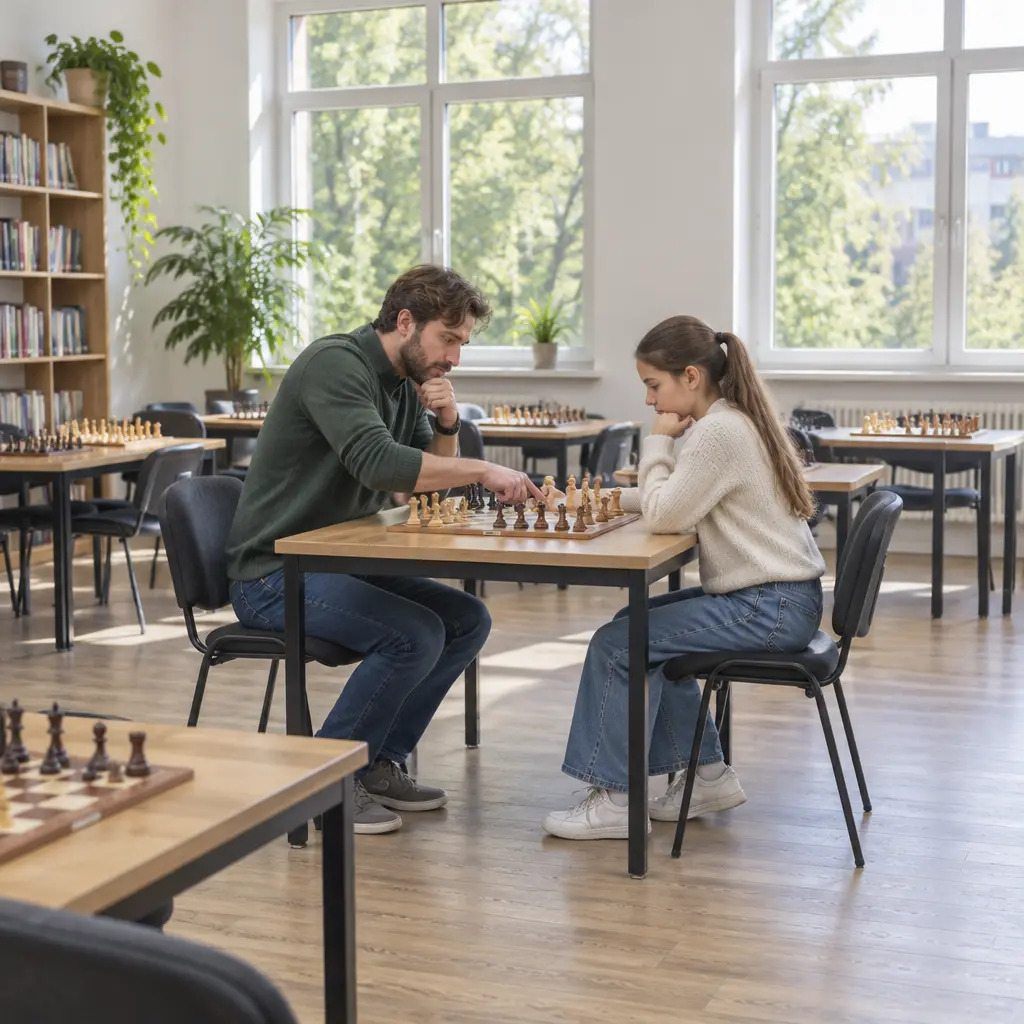
Chess-based social-emotional learning (SEL) uses the decisions, emotions, and interactions of chess to help students practice skills such as self-management, responsible decision-making, and learning from setbacks. Treating a loss as information—not proof of personal failure—can make a game a low-stakes setting for reflection and strategy revision. Research supports chess as a promising educational activity, but evidence that chess alone reliably improves academic or emotional outcomes is mixed; its value is strongest when educators deliberately teach, model, and assess the SEL skills involved.
Learning from loss as a chess-based SEL practice
Social-emotional learning is the process through which people develop and apply knowledge, attitudes, and skills to understand and manage emotions, pursue goals, show empathy, build relationships, and make responsible decisions. CASEL, the Collaborative for Academic, Social, and Emotional Learning, organizes these capabilities into five related areas: self-awareness, self-management, social awareness, relationship skills, and responsible decision-making.
In chess, a loss can become useful feedback when students identify what happened, distinguish a mistaken move from their identity or ability, and choose a next step. The distinction matters: “I missed a threat in this position” describes a reviewable decision; “I’m bad at chess” turns one outcome into a fixed judgment. The approach connects emotional regulation, analytical review, peer communication, and goal-setting rather than treating winning as the only measure of progress.
The need for intentional SEL is well documented, though statistics should not be mistaken for proof that chess itself produces the benefits. A 2011 meta-analysis by Joseph Durlak and colleagues examined 213 universal school-based SEL programs involving 270,034 students. Compared with control groups, participating students showed an 11-percentile-point gain in academic achievement, on average. That finding supports well-designed SEL programs broadly; it does not establish that chess instruction alone causes the same gains.
Chess reflection and the SEL attribute pairing
The attribute pairing “chess-based reflection” means using a student’s moves and game experience as observable material for reviewing thinking, emotion, and choice. It is not a formal diagnostic method or a claim that every loss teaches a lesson automatically. The National Research Council’s account of learning emphasizes that learners develop understanding by connecting new experience with prior knowledge and reflecting on what they did; in a classroom, a game review can provide a concrete occasion for that process.
The pairing has several forms, or hyponyms: move analysis, emotional check-ins, opponent-centered review, and next-game goal setting. Each focuses attention on a different part of the experience. Move analysis examines the position; an emotional check-in notices reactions; opponent-centered review considers another person’s choices; and goal setting turns observations into a plan. Together, they make the bridge from “I lost” to “What can I learn, and what will I try?”
Loss as data, not a verdict
Loss-as-data is a teaching frame in which an outcome is treated as evidence about a particular game, decision, or strategy—not as a verdict on a student’s worth or future potential. A teacher might ask, “Which move changed the position most?” rather than “Why did you play so badly?” Students can then look for a missed threat, an unsupported plan, time pressure, or a tactical opportunity they did not notice.
This frame aligns with research on achievement goals and learning-oriented feedback: specific information about a task gives learners something actionable, whereas person-level labels can make ability seem fixed. Carol Dweck’s research on mindsets is often summarized as a case for praising effort, but a more useful classroom application is to recognize effective strategies, help-seeking, persistence, and revision—not effort in isolation. A student may work hard with an ineffective plan and still need a better one.
Self-management and emotional regulation
Self-management is the capacity to regulate emotions, thoughts, and behavior in pursuit of goals. Chess offers visible moments for practice: pausing after a surprising move, managing frustration after a blunder, and deciding whether to resign or continue respectfully. Teachers can model a brief reset routine—pause, breathe, name the feeling, and identify the next useful action—without implying that students must hide disappointment.
The American Psychological Association describes stress as a response that can affect attention, memory, and decision-making. A classroom chess game is not equivalent to high-stakes stress, but it can give students a manageable opportunity to notice how emotion affects thought. The instructional goal is not to eliminate disappointment; it is to help students respond safely and thoughtfully when disappointment occurs.
Responsible decisions and strategic revision
Responsible decision-making involves considering consequences, evaluating information, and choosing actions that support goals and well-being. In chess, students can reconstruct a critical moment: What did I see? What did I overlook? Which candidate moves were available? What would I inspect next time? This sequence turns review into decision practice rather than a search for someone to blame.
The format also helps distinguish chance from controllable choices. A student cannot control an opponent’s skill or every game outcome, but can practice checking for threats, managing time, and reviewing a position before moving. Teachers should keep the analysis age-appropriate and avoid equating a single tactical error with a broad personal weakness.
Relationship skills and respect for an opponent
Relationship skills include communicating clearly, cooperating, resolving conflict, and showing respect. Chess makes these behaviors observable through turn-taking, sportsmanship, and post-game conversation. A structured exchange—“One choice you handled well was…” followed by “One position I want to review is…”—can encourage specific, respectful feedback.
The opponent is not simply an obstacle: their moves provide information about the position and their plan. Asking students to identify an opponent’s effective decision can support perspective-taking and reduce the idea that a loss is a personal rejection. This works best when feedback is voluntary, supervised, and focused on the game rather than on ranking classmates.
Evidence, limits, and classroom application
Chess has a plausible educational role because it requires planning, attention, rule-following, and evaluation of alternatives. However, those features do not by themselves prove that chess improves academic achievement or SEL. The 2016 review by Giovanni Sala and Fernand Gobet found that claims about far transfer from chess to general cognitive and academic abilities require caution, in part because study design and comparison conditions affect results. A chess club can be engaging and valuable without promising that playing will automatically raise test scores or make every student more resilient.
A practical program therefore teaches both chess and reflection explicitly. A teacher can set a process goal before play, observe emotional and social behaviors during the game, and guide a short review afterward. For example, a student who loses after overlooking a fork might name the position, describe what they were considering, and set the next-game goal “check for opponent threats before I move.” The goal is specific, observable, and within the student’s control.
A short post-game routine
A consistent routine helps normalize both wins and losses. It should protect student dignity and avoid turning every game into a public performance review.
- Pause and name the result without judgment: “I won,” “I lost,” or “We drew.”
- Notice one feeling and one physical cue, such as frustration, excitement, or a tense jaw.
- Choose one key position and describe what each player’s plan may have been.
- Identify one useful decision and one moment to reconsider, using game-specific language.
- Set one small next-game goal and, where appropriate, thank the opponent for the game.
Assessment that values learning, not just wins
Assessment should track behaviors the program is designed to teach: whether a student can pause before reacting, explain a decision, consider an opponent’s perspective, use feedback, or revise a strategy. A simple teacher checklist or student reflection log can record these indicators over time. Win-loss records may describe competitive outcomes, but they are a poor stand-alone measure of emotional growth or learning.
Schools should also consider access and inclusion. Students differ in chess experience, language, disability-related needs, and comfort with competition. Cooperative puzzles, paired analysis, unrated games, and the option to observe or take a break can help ensure that the activity remains a supportive learning environment rather than a source of avoidable shame.
Conclusion: make every game a chance to learn
Chess-based reflection can connect self-management, responsible decision-making, and relationship skills through a memorable shared activity. Its central lesson is not that losing is pleasant or that every defeat guarantees improvement. Rather, a loss can provide specific evidence about a move, a plan, or a response—and students can use that evidence without turning it into a judgment about who they are.
Educators can put the idea into practice by modeling calm review, asking precise questions, setting process goals, and assessing SEL behaviors alongside chess knowledge. To strengthen a program, consult CASEL’s framework, review the research on school-based SEL and chess education, and evaluate outcomes locally instead of assuming benefits. The broader implication is simple: when adults respond to mistakes with curiosity and useful feedback, students get more chances to practice doing the same for themselves and one another.
Sources: Collaborative for Academic, Social, and Emotional Learning (CASEL), What Is the CASEL Framework?, https://casel.org/fundamentals-of-sel/what-is-the-casel-framework/; Durlak, J. A., Weissberg, R. P., Dymnicki, A. B., Taylor, R. D., and Schellinger, K. B., 2011, “The Impact of Enhancing Students’ Social and Emotional Learning: A Meta-Analysis of School-Based Universal Interventions,” Child Development, https://doi.org/10.1111/j.1467-8624.2010.01564.x; National Research Council, 2000, How People Learn: Brain, Mind, Experience, and School, National Academies Press, https://doi.org/10.17226/9853; American Psychological Association, Stress Effects on the Body, https://www.apa.org/topics/stress/body; Sala, G., and Gobet, F., 2016, “Do the Benefits of Chess Instruction Transfer to Academic and Cognitive Skills? A Meta-Analysis,” Educational Research Review, https://doi.org/10.1016/j.edurev.2016.02.002; Dweck, C. S., 2006, Mindset: The New Psychology of Success, Random House.